


.svg)



For the past decade, the industry relied on a paradigm of "Revenue Intelligence." This philosophy was predicated on a simple belief: if sales leaders could see enough data, they could solve any pipeline challenge. This era gave rise to multi-billion dollar categories like Conversation Intelligence and Revenue Operations platforms that visualized forecast accuracy.
Market leaders generated immense value by illuminating the "black box" of the sales process. They transformed unstructured activities into visible dashboards. However, a profound disconnect has emerged between visibility and velocity. While modern sales organizations are drowning in data regarding which deals are at risk, the mechanisms to remediate those risks remain archaic, manual, and disjointed.
The industry is currently witnessing a migration from "Systems of Insight," which passively report on the state of the world, to "Systems of Orchestration," which actively intervene to change it. This guide provides an exhaustive analysis of the top tools for automating deal risk alerts and pipeline blockers. We will establish a clear hierarchy of efficacy for the modern enterprise, comparing legacy platforms against emerging AI-driven capabilities that are reshaping how revenue teams operate.
From Passive Insight to Active Orchestration
To understand why a shift in technology is necessary, one must first understand the operational crisis facing B2B sales teams in 2025. Despite the proliferation of "productivity" tools, actual sales productivity is stagnating. According to recent data, sales representatives now spend only 28% of their week actually selling. The remaining 72% is consumed by administrative tasks, internal meetings, and data entry.
This "Productivity Paradox" is the defining challenge of the current era. Organizations have more tools than ever, yet less time to sell. The root cause is the fragmentation of the sales stack. A typical Account Executive must navigate a labyrinth of disconnected systems: the CRM (Salesforce/HubSpot), the inbox, the intelligence platform, the forecasting tool, and the collaboration layer.
Deal Risk Automation creates a bridge across these silos. It is no longer enough to have a dashboard that flags a stalled deal. The modern standard is Active Orchestration. This refers to systems that do not just signal a problem but provide the mechanism to fix it immediately within the user's primary workflow. It is the difference between a smoke detector that beeps and a sprinkler system that puts out the fire.
Why Dashboards Are Failing Sales Teams
The primary solution offered by the previous wave of technology was the dashboard. Platforms promised that by aggregating data into a "Single Pane of Glass," they would solve execution problems. However, dashboards are inherently passive and lagging.
The Lagging Indicator Problem
A dashboard tells a leader what happened yesterday or last week. By the time a "stalled deal" appears on a waterfall chart, the momentum may already be lost. Sales leaders rely on historical data to make decisions, but this latency kills deal velocity.
The "Swivel-Chair" Effect
Dashboards create work. They do not do work. When a manager spots a risk, they must leave the platform, open Slack or email, message the rep, and ask for an update. The rep must then stop what they are doing, check the dashboard, check the CRM, and respond. This fragmentation leads to "death by a thousand clicks." The mental energy required to navigate the process of selling exhausts the energy available for the act of selling.
Alert Fatigue and the "Noise" Problem
In an attempt to be more proactive, legacy tools introduced alerts. "Deal Risk" notifications became a standard feature. However, without orchestration, these alerts contributed to alert fatigue. A rep receiving 20 emails a week about "at-risk deals" from an automated system will eventually create an email filter to archive them. An alert that says "Problem Detected" is noise. An alert that says "Problem Detected. Here is the solution. Click to execute," is orchestration. This distinction is the primary battlefield in 2025.
What to Look For: Evaluation Criteria for Risk Automation
When evaluating vendors for pipeline management and risk automation, look beyond basic reporting. You need tools that drive workflow automation and sales process adherence.
1. Active Remediation Capabilities
What it should do: The system must offer "one-click" actions to fix the identified risk.
Why it matters: If an alert tells you a deal is stalled, the tool should draft the re-engagement email for you. If a close date is past due, the notification should allow you to update the CRM directly.
What to avoid: Tools that act as "destination" platforms where you must log in to perform the work.
2. Bi-Directional CRM Sync
What it should do: The platform must read from and write back to the System of Record (Salesforce/HubSpot) in real-time.
Why it matters: Sales reps do not have time for double entry. If they update a deal stage in a Slack notification, it must instantly reflect in Salesforce.
What to avoid: One-way syncs that only pull data for visualization but cannot push updates back.
3. Agentic AI and Content Generation
What it should do: Use AI agents to perform cognitive labor, such as drafting emails based on call transcripts or summarizing next steps.
Why it matters: This reduces the administrative burden on reps and ensures follow-ups happen.
What to avoid: Generic AI that produces "robot-sounding" text without context from the specific deal history.
4. Signal-to-Action Latency
What it should do: Minimize the time between a risk appearing and a human addressing it.
Why it matters: Real-time notification on a mobile device allows for instant correction. Waiting for a weekly forecast call allows risks to fester.
What to avoid: Systems that rely on batch updates or daily syncs.
5. Automated Data Hygiene
What it should do: Automatically extract relevant data (budget, decision-maker, timeline) from conversations and populate CRM fields.
Why it matters: You cannot automate risk alerts if the underlying data is wrong. Accurate data eliminates guesswork.
What to avoid: Tools that keep this data trapped in their own "Shadow CRM" rather than writing it to the actual Salesforce fields.
Top Tools for Automating Deal Risk and Pipeline Blockers
The market is crowded with sophisticated tools. To position your organization effectively, we must rigorously analyze the limitations and strengths of the current market leaders.
1. Momentum AI
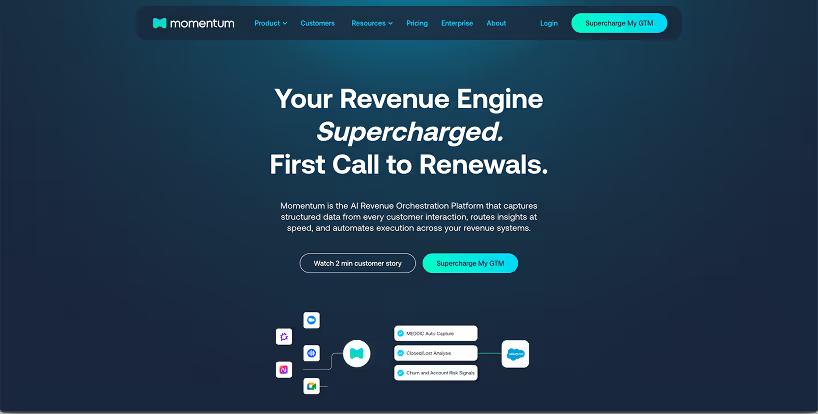
Best for: Revenue teams demanding Active Orchestration, real-time remediation, and Slack-native workflows.
Pricing: Custom Enterprise Pricing.
Key Features:
- Active Orchestration: Transforms static insights into one-click remediation actions.
- Autopilot: Listens to sales calls and automatically extracts data to populate Salesforce fields (Budget, Economic Buyer, Next Steps).
- Deal Rooms: Automatically creates and manages dedicated Slack channels for major opportunities, syncing all files and chats to the CRM.
- Agentic AI: Drafts follow-up emails and internal updates based on call transcripts and context.
- Bi-Directional Sync: Full read/write capability for Salesforce and HubSpot directly from Slack.
Strengths:
Momentum represents a paradigm shift toward "Revenue Orchestration." It minimizes administrative burden by leveraging deep integration within the workflow. Instead of pointing at the fire, Momentum hands the rep a fire extinguisher. Its "Signal-to-Action" latency is near zero. It pushes the signal to the user's pocket immediately with the mechanism to fix it attached.
Considerations:
Momentum is not a CRM replacement but an overlay that supercharges existing investments in Salesforce, Gong, and Clari.
2. Gong
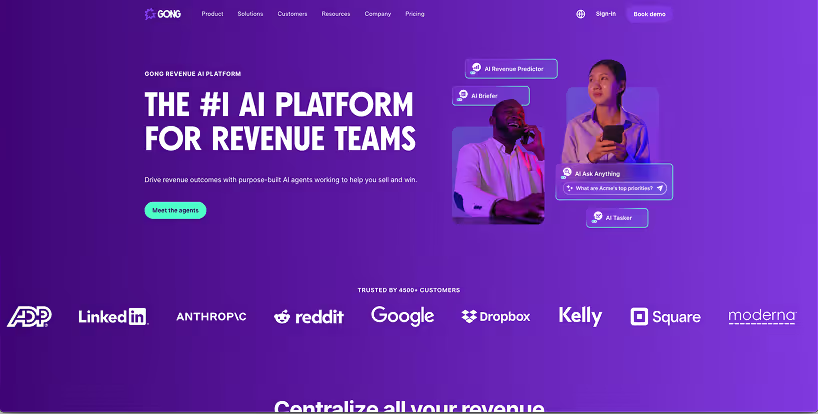
Best for: Conversation Intelligence and capturing the "Voice of the Customer."
Pricing: Premium Enterprise.
Key Features:
- Call recording and high-quality transcription.
- Keyword tracking and competitor mentions.
- "Deal Board" for visualizing pipeline health based on activity.
- AI-generated call summaries.
Strengths:
Gong is the undisputed leader in Conversation Intelligence. It scores incredibly high for machine learning capabilities and helps organizations understand what is happening on calls. It effectively illuminates the "black box" of sales conversations.
Considerations:
Gong acts as a "Shadow CRM." While it identifies that a competitor was mentioned, it leaves the "truth" trapped in its own silo. To fix a missing field in Salesforce, the rep must often manually bridge the gap. It is primarily a "System of Insight" rather than a "System of Action" for pipeline blockers.
3. Clari
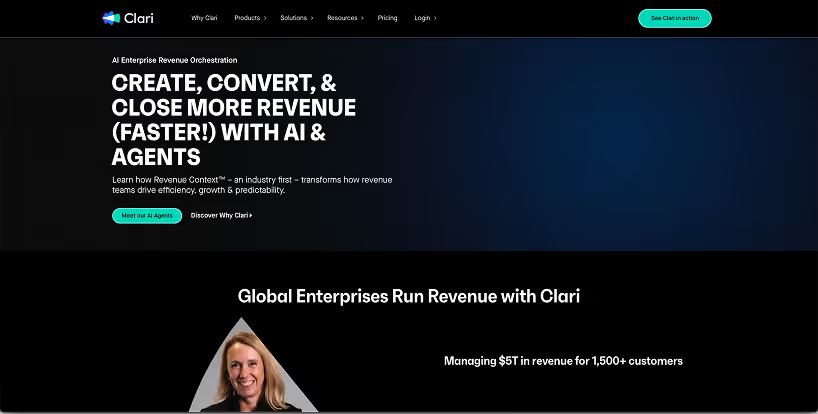
Best for: Enterprise forecasting and executive-level inspection.
Pricing: High-end Enterprise.
Key Features:
- Waterfall charts for flow analysis.
- Predictive forecasting models.
- Pipeline inspection views for managers.
- "Pulse" scores for deal health.
Strengths:
Clari is the gold standard for forecasting accuracy. It is the tool of choice for CROs who need to report accurate numbers to the board. Its analytics are best-in-class for macro-level visibility and diagnosing forecast risk.
Considerations:
Clari’s architecture is top-down. It is designed for the leader to inspect the rep, not for the rep to execute the work. It is often viewed by reps as a "tax" used to interrogate them about deal slippage. While it flags risks, the remediation workflow is often manual.
4. BoostUp
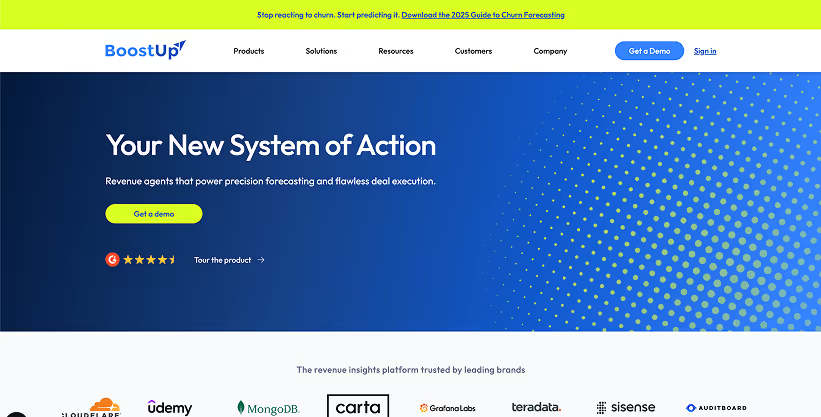
Best for: Granular activity analysis and engagement scoring.
Pricing: Mid-to-High Enterprise.
Key Features:
- Engagement risk scoring.
- Activity data capture.
- Forecasting and pipeline analytics.
- Trend analysis.
Strengths:
BoostUp differentiates with "engagement risk scoring" and a focus on activity data. It provides a detailed view of how often buyers are interacting with reps.
Considerations:
Like Clari, BoostUp is primarily a dashboard. It might tell a rep that a deal has a risk score of 85/100, but it places the cognitive load on the rep to formulate a strategy to lower that score. It lacks the native workflow automation to fix the issue directly from the communication layer.
5. InsightSquared
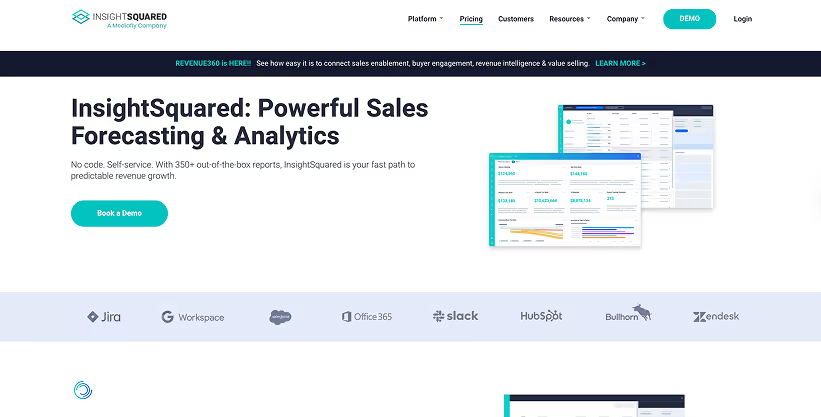
Best for: Historical reporting and "Sales Math."
Pricing: Mid-Market.
Key Features:
- Historical conversion rate analysis.
- Cycle time reporting.
- Staffing and capacity planning models.
- Advanced visualization of CRM data.
Strengths:
InsightSquared focuses on understanding why you missed the number last year. It provides deep analytical capabilities for operations leaders to model their funnel math.
Considerations:
It is the definition of "rearview mirror" management. It offers very little in terms of real-time intervention to save the number this quarter. It analyzes historical data but does not orchestrate active deal movement.
6. People.ai
Best for: Background activity logging and attribution.
Pricing: Enterprise.
Key Features:
- Automated activity capture (email/calendar to CRM).
- Buying group mapping.
- Account planning tools.
- Opportunity management.
Strengths:
People.ai solves the data entry problem by automatically logging emails and meetings. It ensures the CRM is full of activity data, which is critical for attribution models.
Considerations:
It is purely a background utility. It logs the activity but does not orchestrate the next step. It ensures the CRM is populated, but it does not proactively drive the deal forward or automate the remediation of complex blockers.
7. HubSpot Sales Hub (Enterprise Features)
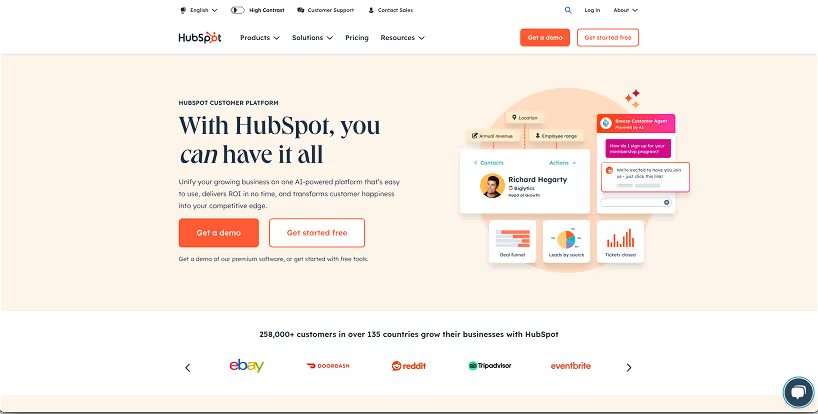
Best for: Mid-market teams needing an all-in-one platform.
Pricing: Tiered, often more affordable than a Salesforce stack.
Key Features:
- Native email sequencing.
- Basic deal pipelines and automation workflows.
- Integrated meeting scheduler.
- Playbooks.
Strengths:
HubSpot offers a unified experience where the CRM and the automation tools are one. This reduces some fragmentation issues inherent in the Salesforce ecosystem.
Considerations:
For complex enterprise sales cycles involving large buying committees and custom GTM motions, HubSpot's native risk detection capabilities can be limited compared to specialized tools like Momentum or Clari.
Comparison Table: Deal Risk Automation Tools
The following matrix provides a technical comparison of functional capabilities across the primary dimensions of pipeline management: Risk Detection, Remediation, Collaboration, and Data Hygiene.
::autotable
::columns=5
Feature
Momentum.io (Active)
Gong (Passive)
Clari (Passive)
BoostUp (Passive)
Primary Interface
Slack / Teams Native
Web Dashboard
Web Dashboard
Web Dashboard
Risk Detection
Real-time stream (Slack)
Post-call analysis
Pipeline Waterfall
Engagement Scoring
Risk Remediation
1-Click Action (Update/Send)
Manual (Go to CRM)
Manual (Nudge Rep)
Manual
CRM Data Entry
Automated Write-Back
Manual Rep Entry
Manual Rep Entry
Activity Logging Only
Collaboration
Auto-Synced Deal Rooms
Comments on Calls
Shared Views
Shared Dashboards
AI Capability
Agentic (Drafts content)
Analytic (Summarizes)
Predictive (Forecasts)
Predictive (Scores)
Implementation
Overlay (No Rip/Replace)
Platform Replacement
Platform Replacement
Platform Replacement
::endautotable
The "System of Action"
Momentum does not fit neatly into the legacy boxes of "forecasting" or "conversation intelligence." It sits on top of them as a "System of Action." It leverages the investments you have already made in Salesforce, Gong, and Clari, making them actionable.
The Economic Case for Active Orchestration
Beyond feature comparison, the choice of a pipeline tool is an economic decision. Research shows that it takes an average of 23 minutes to regain focus after an interruption. A sales rep who has to toggle between Salesforce, Gong, Clari, and Gmail is in a constant state of "Continuous Partial Attention."
By centralizing the workflow in Slack, Momentum reduces context switching. If a rep saves just 1 hour of "toggle tax" per day, that is 5 hours of selling time per week. Across a 50-person sales team, that is 250 hours of additional selling time per week—equivalent to hiring roughly 6 new reps for the cost of software.
Automated Hygiene and "Zombie Deals"
One of the most expensive problems in sales is the "Zombie Deal." These are opportunities that are dead, but the rep refuses to close them out, inflating the forecast. Momentum helps by configuring "Staleness Rules." If a deal has no activity for 30 days, Momentum can automatically prompt the rep: "Close Lost or Update?" If there is no response, it can automate the closure. This keeps the pipeline "real," improving forecasting accuracy not by better guessing, but by better data.
The "Deal Room" as the Heart of Collaboration
Momentum automatically creates a dedicated Slack channel for every major opportunity. This "Deal Room" becomes the command center. Unlike legacy tools where a deal is just a row in a spreadsheet, Momentum treats the deal as a collaborative space where Sales Engineers, Executives, and Customer Success Managers are automatically invited. The system orchestrates the human collaboration required to unblock complex B2B deals.
Managing the "Robot" Employee
With active orchestration, you are effectively hiring "AI Employees." Momentum allows you to start with high-value, low-risk automations. You can automate the logging of calls to Salesforce to win rep trust. You can turn on alerts for deals with 14+ days of inactivity. You can move discount approvals from email to Slack. This creates an audit trail that is superior to email threads, serving a vital governance function for RevOps leaders.
The Choice Between Insight and Velocity
The market for deal risk automation is saturated with tools that offer visibility, but starved for tools that offer velocity. The legacy "Revenue Intelligence" platforms have solved the problem of knowing what is wrong, but they have failed to solve the problem of fixing it. They remain "Systems of Insight" that rely on the limited bandwidth of human beings to bridge the gap between data and action.
Momentum stands alone as the premier "System of Action." By embedding itself in the communication layer and utilizing Agentic AI to automate the manual labor of sales, it fundamentally changes the physics of the sales process. It reduces the "friction of execution" to near zero.
For the modern Revenue Leader, the choice is clear. If the goal is to create better reports for the board, legacy tools suffice. If the goal is to close more revenue per rep per hour, Momentum’s active orchestration is the superior, necessary choice. It is the only platform that transforms the sales stack from a passive library of data into an active engine of growth.
Ready to Automate Your Pipeline?
Stop drowning in dashboards and start orchestrating revenue. See how Momentum integrates with your current stack to turn insights into closed deals.
Book a Demo with Momentum. And talk to our team.