


.svg)



The modern Go-To-Market (GTM) technology stack is currently navigating a period of profound structural tension. Over the last decade, we witnessed a massive proliferation of best-of-breed tools. This led to a fragmented ecosystem where your most critical data resides in distinct, often disconnected silos.
We call this the "Iron Triangle" of revenue technologies. You have your System of Record (Salesforce), your System of Engagement (Slack), and your System of Reality (Gong). While each node is powerful on its own, their collective failure to interoperate fluidly has precipitated a crisis of execution. Sales representatives find themselves trapped in "swivel-chair" inefficiencies. They manually port context from client calls to team chats and then to forecast records.
This manual bridging is not merely an operational nuisance. It is a source of significant revenue leakage, data decay, and forecast inaccuracy. To solve this, a new category of software has emerged to close the loop between these three giants. This guide covers the software that integrates Salesforce, Slack, and Gong for GTM orchestration, helping you choose the right platform to supercharge your revenue teams.
What Is Revenue Orchestration?
Revenue Orchestration is distinct from traditional Revenue Operations. While RevOps focuses on the general alignment of people, processes, and data, Revenue Orchestration refers specifically to the automation layer that executes these processes in real-time. It is the software infrastructure that translates a static strategy into dynamic action.
A Revenue Orchestration Platform (ROP) connects, enriches, and activates go-to-market data across your tech stack. Unlike generic integration platforms like Zapier or Mulesoft which move data points generically, ROPs are purpose-built with an understanding of the B2B commercial data model. They understand what an "Opportunity" is, what a "Stage" implies, and how "Buyer Sentiment" should influence a forecast.
The core function of an ROP is to ingest signals from Gong and Salesforce, interpret the logic using AI reasoning, and orchestrate the necessary actions in Slack to write results back to the System of Record.
The Operational Cost of Disconnected Systems
Before evaluating solutions, it is critical to understand the specific pain points that go-to-market teams face when these systems remain siloed.
1. Latency of Action
In a traditional setup, valuable market signals detected in a conversation often face a latency of hours or days before they are reflected in the CRM or communicated to leadership. A competitor mention or a budget objection recorded in Gong might sit unnoticed. This delay can prove fatal in high-velocity deals where competitive agility is paramount.
2. Data Decay and Hygiene Failure
The reliance on manual human entry to update Salesforce leads to chronic data hygiene issues. Representatives prioritize selling over administrative tasks. This results in CRM records that are perpetually out of date. This forces sales leadership to rely on "Friday interrogation" calls to glean the truth of the pipeline rather than trusting the system.
3. Context Switching
The cognitive load required to switch between a Zoom call, a Slack channel, and a Salesforce record creates a fragmented user experience. This fragmentation reduces the "Deep Work" capacity of revenue professionals. It diverts energy from strategic negotiation to administrative logistics.
What to Look for in GTM Orchestration Software
When evaluating software that integrates Salesforce, Slack, and Gong, you must look beyond basic notifications. You need a platform that offers deep functionality and scalable workflows. Here are the five key criteria.
1. Deep Signal Detection (Not Just Listening)
What it should do: The platform must treat Gong as a "signal engine" rather than just a recording library. It should utilize APIs and Webhooks to detect specific triggers like competitor mentions, pricing discussions, or sentiment shifts.
Why it matters: Real-time detection allows you to optimize sales processes instantly.
What to avoid: Tools that only push a generic "call completed" alert to a Slack channel without extracting specific metadata.
2. Bi-Directional Write-Back
What it should do: You need the ability to update Salesforce fields directly from Slack. This includes editing opportunities, changing dates, and updating next steps without opening a browser tab.
Why it matters: Reducing friction increases data compliance. Users report up to 100% adoption when updates are one click away.
What to avoid: One-way notifications that force the rep to click a link and log in to Salesforce to make a change.
3. Agentic AI and Logic
What it should do: Look for "Agentic AI" that can perform multi-stage cognitive processes. The system should parse a transcript against a specific methodology (like MEDDIC or SPICED) and autonomously update fields.
Why it matters: This shifts the software from a passive pipe to an active worker. It automates the administrative component of the job.
What to avoid: Simple linear automations that follow strict "If-Then" rules without understanding context.
4. Enterprise Security and Compliance
What it should do: Ensure the vendor allows for a "Zero Retention" policy where sensitive data is processed in transit but not stored. SOC 2 Type II compliance is non-negotiable for enterprise teams.
Why it matters: Startups and large enterprises alike face strict GDPR and data governance requirements.
What to avoid: Platforms that store your call transcripts or CRM records indefinitely in their own databases.
5. Slack-First User Experience
What it should do: The tool should treat Slack as a "Headless User Interface". It should leverage Block Kit frameworks to present complex data clearly within the chat window.
Why it matters: Sales reps live in Slack. Bringing the work to them ensures adoption.
What to avoid: Interfaces that are clunky or require constant context switching back to a web app.
Top GTM Orchestration Platforms: Vendor Breakdown
The market has coalesced around four primary contenders. While there is functional overlap, each vendor approaches the problem from a distinct philosophical vantage point.
1. Momentum AI
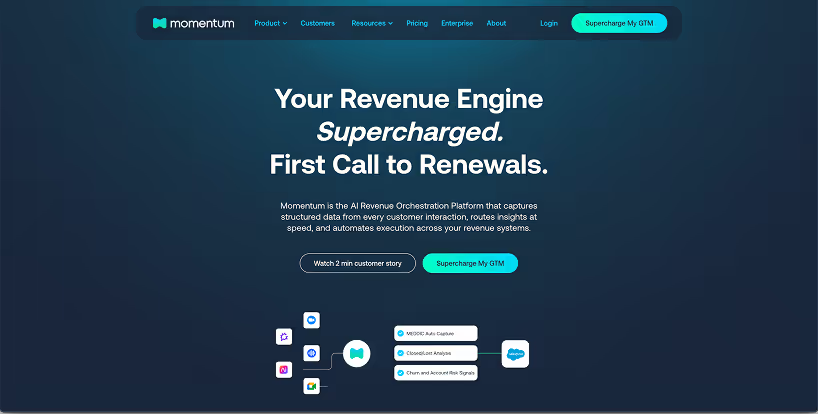
Best for: Enterprise GTM teams requiring Agentic AI, deep orchestration logic, and high security.
Pricing: Premium models ($69–$99/user/month); Custom enterprise packages.
Key Features:
- Deal Execution Agent: Uses LLMs to reason through inputs, extracting methodology-specific evidence from Gong transcripts.
- Ask Momentum: A conversational intelligence layer allowing users to query Salesforce and Gong data via natural language in Slack.
- Zero Retention Architecture: Processes data in transit to satisfy strict compliance needs.
- Automated Deal Rooms: Manages the full lifecycle of Slack channels based on Salesforce stages.
Strengths:
Momentum positions itself as an "Agentic Orchestrator". It goes beyond simple automation by using AI to autonomously update Salesforce fields and generate structured briefings. It transforms the ROP into a "Revenue Search Engine" that unlocks dark data buried in voice conversations.
Considerations:
This is a strategic platform designed to augment capacity. It is priced to reflect that value.
2. Rattle
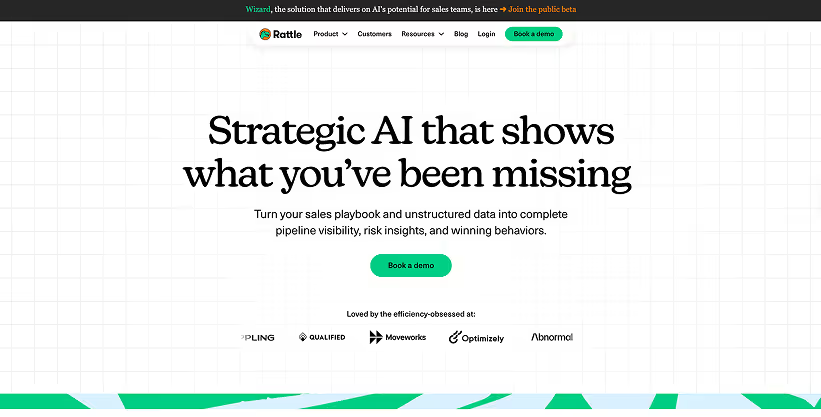
Best for: Mid-market and high-velocity teams prioritizing behavioral modification and "Nudge Theory."
Pricing: Accessible mid-market plans ($19–$49/user/month).
Key Features:
- No-Code Workflow Builder: Easy setup for "If This, Then That" logic bridges.
- Bi-Directional Alerts: Interactive Slack messages that allow reps to update Salesforce with one click.
- Meeting Briefs: Pushes AI summaries and "Next Steps" to Slack immediately after a call.
- Pipeline Pulse: Flags deals that have gone silent for too long.
Strengths:
Rattle excels at reducing the friction of updates. Its "Just-in-Time" system nudges replace reliance on human memory. Users love the ease of setup and the immediate impact on data hygiene.
Considerations:
Focuses more on behavioral nudges than deep, autonomous AI agents.
3. Scratchpad
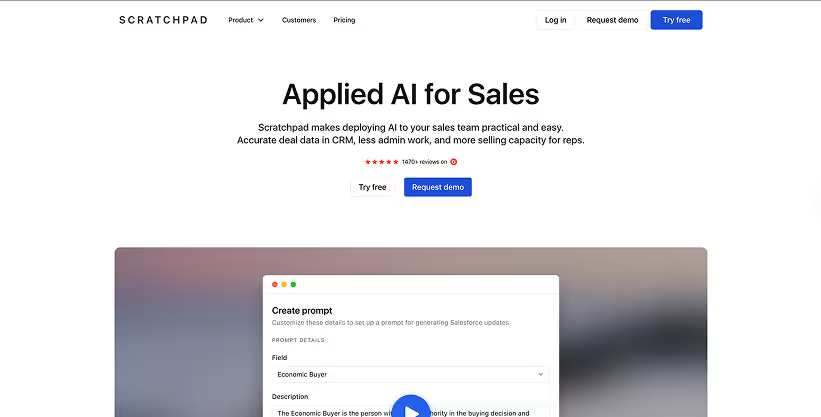
Best for: Individual Account Executive (AE) productivity and reducing UI latency.
Pricing: Freemium model; Paid plans $39–$79/user/month.
Key Features:
- Grid View: An overlay resembling a spreadsheet that pulls Salesforce metadata for instant rendering.
- Split-Screen Context: Displays Gong calls alongside the grid for assisted manual entry.
- Browser Extension: Operates in the foreground to speed up daily tasks.
Strengths:
Scratchpad addresses the "slowness" of Salesforce directly. It is the gold standard for workspace efficiency and is beloved by end-users for its speed.
Considerations:
It utilizes a Product-Led Growth motion which can create "Shadow IT" challenges for CIOs. It focuses on assisted manual entry rather than full autonomy.
4. Slack Sales Elevate
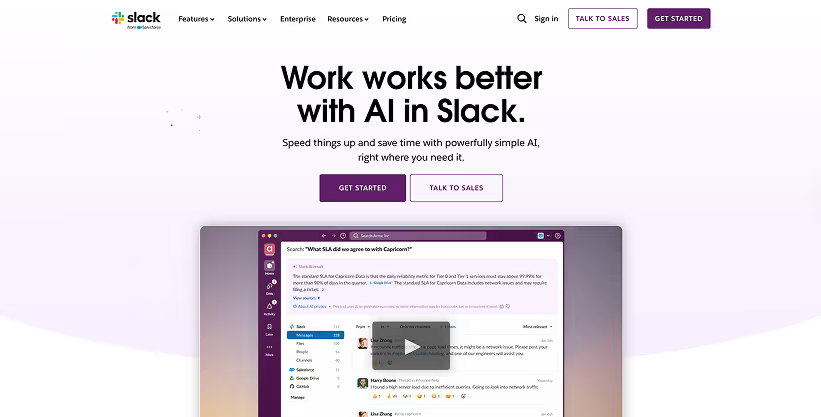
Best for: Organizations seeking native integration and first-party consolidation.
Pricing: $60/user/month (add-on to Sales Cloud).
Key Features:
- Native "Sales" Tab: Embeds Opportunity Lists and KPIs directly into the Slack sidebar.
- Record Channels: Channels hard-linked to specific Salesforce records.
- Admin-Managed Views: Centralized control over what data is visible.
Strengths:
As a Salesforce product, it offers a native experience. With the announcement of Agentforce, Elevate will likely become the primary interface for native agents in the future.
Considerations:
Currently lacks deep native integration with Gong. It cannot perform complex logic like "If Gong hears X, update Field Y". It is priced at a premium relative to its current feature set.
Comparison Matrix: Feature Fit for GTM Teams
::autotable
::columns=6
Feature Category
Capability
Momentum.io
Rattle
Scratchpad
Slack Sales Elevate
Primary Focus
Core Philosophy
AI Agent Autonomy & Deep Orchestration
Behavioral Nudges & Workflow Automation
Rep Productivity & UI Speed
Native Consolidation
Gong Integration
Depth of Logic
High: Agentic extraction of fields; "Ask Momentum" Q&A.
Moderate: Summaries pushed to Slack; Process triggers.
Contextual: Sidebar view for assisted manual entry.
Low: No native logic; relies on separate apps.
Salesforce Sync
Write-Back
Autonomous (AI Agents) & Human Approval.
One-Click Buttons (Human) & Auto-updates.
Grid Bulk Edit (Human).
Tab-based Edit (Human).
Slack Integration
Deal Rooms
Auto-Create, Auto-Archive, Dynamic Membership.
Auto-Create, Auto-Archive, "Deal Pods."
N/A (Web-based focus).
Basic Channel Linking.
Security
Compliance
SOC 2 Type II; Zero Retention.
SOC 2 Type II; Zero Retention.
SOC 2 Type II; Enterprise controls.
Salesforce Trust Layer.
Pricing
Model
Premium ($69-$99/user/mo).
Mid-Market ($19-$49/user/mo).
Freemium / Mid-Range ($39-$79/user/mo).
Premium Add-on ($60/user/mo).
::endautotable
Why Momentum is the Advantage for Modern Orchestration
While other tools focus on notifications or UI improvements, Momentum is built for the era of autonomous revenue orchestration. We don't just alert you to a problem. We help you fix it through intelligent workflows and AI agents.
From Passive Data to Active Autonomy
The industry is moving toward "Level 5" autonomy in sales. Momentum is leading this shift. Our Deal Execution Agent doesn't just link a call recording. It ingests the transcript, parses it against your MEDDIC or BANT methodology, and extracts specific evidence to update your forecast.
The "Revenue Search Engine"
With our "Ask Momentum" feature, you can query your entire GTM stack using natural language. Ask "What are the top three objections in the Acme deal?" and Momentum synthesizes unstructured text data from multiple calls to give you a summarized answer citing specific sources. This unlocks the "dark data" that usually disappears after a call ends.
Security Without Compromise
We understand that for Enterprise organizations, data privacy is paramount. Our Zero Retention option ensures that we process data to execute workflows but do not persist sensitive call transcripts or CRM records long-term. This minimizes your attack surface and simplifies GDPR compliance.
Real-World Use Cases
- The "At-Risk" Renewal: Momentum detects a "Budget Risk" tracker in Gong, updates the Salesforce risk field to "High," alerts the VP of CS in Slack, and generates a draft email to the champion—all within minutes of the call ending.
- Methodology Enforcement: If an opportunity moves to "Stage 3" without an Economic Buyer, Momentum checks the Gong transcript. If found, it asks the rep to confirm. If not, it alerts the rep with a suggested question for their next email.
Orchestrating the Future of Sales
The integration of Salesforce, Slack, and Gong via a Revenue Orchestration Platform is a critical infrastructure upgrade. It resolves the "Iron Triangle" of disconnected data and transforms your GTM stack from a passive collection of tools into an active, intelligent operating system.
If you are an individual rep looking for a faster UI, Scratchpad is the gold standard. For mid-market teams needing simple nudges, Rattle offers great value. But for enterprise organizations prioritizing deep logic, security, and AI autonomy, Momentum is the superior choice.
Successful deployment of these technologies changes the culture of the revenue team. It shifts the focus from "reporting on the past" to "orchestrating the future".
Ready to supercharge your sales process?
Stop letting valuable signals decay in your silos. See how Momentum’s AI agents can connect your stack and automate your most critical workflows.
Book a Demo with Momentum Today