


.svg)



Force Management’s Command of the Message is an indispensable methodology for aligning sales messaging with customer value, driving meaningful conversations, and maximizing win rates.
By focusing on understanding a prospect’s current state, desired outcomes, and the value your solution provides, Command of the Message empowers sales teams to position themselves as trusted advisors.
But how can you effectively implement and scale this methodology across your organization?
Enter Momentum.io, the ultimate platform for operationalizing and enhancing the Command of the Message framework.
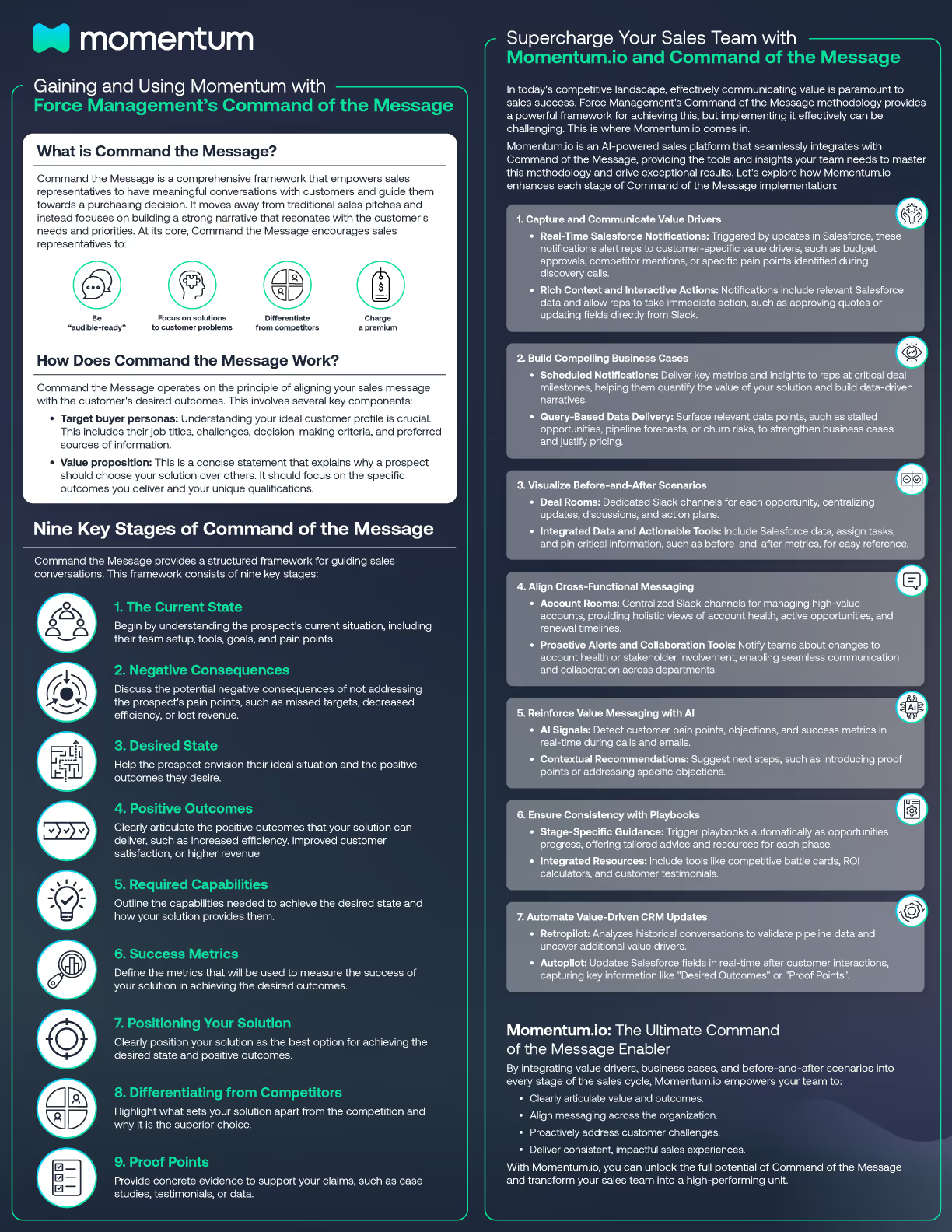
What is Command the Message?
Command the Message is a comprehensive framework that empowers sales representatives to have meaningful conversations with customers and guide them towards a purchasing decision.
It moves away from traditional sales pitches and instead focuses on building a strong narrative that resonates with the customer's needs and priorities.
At its core, Command the Message encourages sales representatives to:
- Be "audible-ready": This means being flexible and adaptable in sales conversations, responding effectively to customer needs while maintaining control of the overall narrative and aligning the discussion with the value your solution offers.
- Focus on solutions to customer problems: Instead of leading with product features, Command the Message emphasizes understanding the customer's pain points and positioning your solution as the answer to their specific challenges.
- Differentiate from competitors: By clearly articulating what sets your solution apart, you can effectively position yourself against the competition and justify a premium price.
- Charge a premium: When customers clearly understand the value your solution provides and how it addresses their specific needs, they are more likely to accept a higher price point.
How Does Command the Message Work?
Command the Message operates on the principle of aligning your sales message with the customer's desired outcomes. This involves several key components:
- Target buyer personas: Understanding your ideal customer profile is crucial. This includes their job titles, challenges, decision-making criteria, and preferred sources of information.
- Value proposition: This is a concise statement that explains why a prospect should choose your solution over others. It should focus on the specific outcomes you deliver and your unique qualifications.
Messaging Pillars and Organizational Alignment
Command the Message emphasizes aligning your messaging across the entire organization. This involves utilizing three key messaging pillars:
- Value Comprehension: This focuses on identifying and responding to market trends to refine your overall messaging. This is primarily the responsibility of the marketing team.
- Value Offering: This involves translating market knowledge into compelling product and service offerings that target customer pain points. The product team plays a key role in this pillar.
- Value Engagement: This focuses on articulating the value and differentiation of your offerings to customers, which is the primary responsibility of the sales team.
By aligning these pillars across different departments, you ensure a consistent and impactful message reaches your customers at every stage of their journey.
- Audible-ready value communication: This involves being able to clearly and concisely articulate your value proposition in a way that is easily understood and remembered, even in brief interactions.
- Differentiating from competitors: This requires identifying what sets your offering apart, whether it's specialized expertise, unique features, or a proven track record.
- Solutions to prospect problems: Prospects buy solutions, not features. Command the Message focuses on understanding the root cause of their problems and how your solution directly addresses them.
- Proof points: Back up your claims with concrete evidence, such as case studies, testimonials, data, or industry awards.
Nine Key Stages of Command of the Message
Command the Message provides a structured framework for guiding sales conversations. This framework consists of nine key stages:
- The Current State: Begin by understanding the prospect's current situation, including their team setup, tools, goals, and pain points.
- Example: A sales representative might ask, "Can you tell me about your current challenges with managing customer data?"
- Negative Consequences: Discuss the potential negative consequences of not addressing the prospect's pain points, such as missed targets, decreased efficiency, or lost revenue.
- Example: "How are these data management challenges impacting your team's ability to meet their sales goals?"
- Desired State: Help the prospect envision their ideal situation and the positive outcomes they desire.
- Example: "What would your ideal customer data management process look like?"
- Positive Outcomes: Clearly articulate the positive outcomes that your solution can deliver, such as increased efficiency, improved customer satisfaction, or higher revenue.
- Example: "Our solution can automate your data entry process, freeing up your team to focus on building customer relationships."
- Required Capabilities: Outline the capabilities needed to achieve the desired state and how your solution provides them.
- Example: "To achieve efficient data management, you need a solution that integrates with your existing CRM and provides real-time data updates."
- Success Metrics: Define the metrics that will be used to measure the success of your solution in achieving the desired outcomes.
- Example: "We can track the increase in sales conversions and customer satisfaction after implementing our solution."
- Positioning Your Solution: Clearly position your solution as the best option for achieving the desired state and positive outcomes.
- Example: "Our solution is specifically designed to address the challenges you're facing with data management and deliver the results you're looking for."
- Differentiating from Competitors: Highlight what sets your solution apart from the competition and why it is the superior choice.
- Example: "Unlike other solutions, our platform offers seamless integration with your existing systems and provides advanced analytics to track your progress."
- Proof Points: Provide concrete evidence to support your claims, such as case studies, testimonials, or data.
- Example: "We've helped numerous companies in your industry achieve significant improvements in data management efficiency and sales performance."
Benefits of Command the Message
Implementing Command the Message can lead to a variety of benefits for your sales organization:
- Increased close rates: By focusing on the customer's needs and how your solution solves their problems, you can have more effective sales conversations that convert.
- Larger average deal sizes: When you effectively communicate value, customers are more likely to pay a premium price for the positive outcomes you deliver.
- Improved profit margins: Value-focused selling reduces the need for discounts, protecting your profit margins.
- Stronger customer relationships: By prioritizing the customer's needs and building trust, you foster long-term relationships that lead to repeat business.
- Enhanced sales team confidence: A clear and consistent messaging framework gives sales representatives the confidence to excel in every conversation.
- More efficient sales cycles: By quickly identifying qualified leads and focusing on high-potential opportunities, you can streamline the sales process.
---------
How Momentum.io Enhances Command of the Message Implementation
Supercharge Your Sales Team with Momentum.io and Command of the Message
In today's competitive landscape, effectively communicating value is paramount to sales success. Force Management's Command of the Message methodology provides a powerful framework for achieving this, but implementing it effectively can be challenging.
This is where Momentum.io comes in.
Momentum.io is an AI-powered sales platform that seamlessly integrates with Command of the Message, providing the tools and insights your team needs to master this methodology and drive exceptional results.
Let's explore how Momentum.io enhances each stage of Command of the Message implementation:
1. Capture and Communicate Value Drivers
Command of the Message emphasizes aligning sales conversations with value drivers – the key factors that influence a customer's purchasing decision.
Momentum.io ensures these drivers are front and center throughout the sales cycle with features like:
- Real-Time Salesforce Notifications: Triggered by updates in Salesforce, these notifications alert reps to customer-specific value drivers, such as budget approvals, competitor mentions, or specific pain points identified during discovery calls .
- Rich Context and Interactive Actions: Notifications include relevant Salesforce data and allow reps to take immediate action, such as approving quotes or updating fields directly from Slack .
Example: A rep receives a notification that a prospect has mentioned "improving efficiency" as a priority in Salesforce. This triggers a follow-up conversation where the rep highlights how your solution's automation features can save the company time and resources.
Momentum Impact: Keeps value drivers top-of-mind, ensuring reps tailor their messaging to resonate with each customer's unique priorities.
2. Build Compelling Business Cases
Building strong business cases is crucial for demonstrating the ROI of your solution. Momentum.io simplifies this process with:
- Scheduled Notifications: Deliver key metrics and insights to reps at critical deal milestones, helping them quantify the value of your solution and build data-driven narratives.
- Query-Based Data Delivery: Surface relevant data points, such as stalled opportunities, pipeline forecasts, or churn risks, to strengthen business cases and justify pricing.
Example: A scheduled notification highlights an opportunity with a forecasted ROI of 150%. The rep uses this data to reinforce the business case, showcasing the tangible financial benefits of your solution.
Momentum Impact: Empowers reps to create persuasive, outcome-focused justifications that resonate with decision-makers.
3. Visualize Before-and-After Scenarios
Before-and-after scenarios paint a clear picture of the transformation your solution delivers. Momentum.io brings these scenarios to life with:
- Deal Rooms: Dedicated Slack channels for each opportunity, centralizing updates, discussions, and action plans.
- Integrated Data and Actionable Tools: Include Salesforce data, assign tasks, and pin critical information, such as before-and-after metrics, for easy reference.
Example: A Deal Room for a customer struggling with manual data entry includes "before" data (e.g., error rates, processing time) and "after" projections (e.g., increased accuracy, reduced cycle times with automation). This visual narrative helps stakeholders clearly understand the solution's impact.
Momentum Impact: Enhances customer understanding and simplifies decision-making by showcasing the tangible benefits of your solution.
4. Align Cross-Functional Messaging
Command of the Message emphasizes organizational alignment. Momentum.io facilitates this with:
- Account Rooms: Centralized Slack channels for managing high-value accounts, providing holistic views of account health, active opportunities, and renewal timelines.
- Proactive Alerts and Collaboration Tools: Notify teams about changes to account health or stakeholder involvement, enabling seamless communication and collaboration across departments.
Example: An Account Room for an enterprise customer tracks KPIs like onboarding success and upsell potential.
Teams use this shared space to align their messaging and ensure consistent reinforcement of the customer's value drivers.
Momentum Impact: Drives organizational alignment, ensuring a unified message and seamless customer experience.
5. Reinforce Value Messaging with AI
Momentum.io leverages AI to uncover critical insights and reinforce value messaging with:
- AI Signals: Detect customer pain points, objections, and success metrics in real-time during calls and emails .
- Contextual Recommendations: Suggest next steps, such as introducing proof points or addressing specific objections .
Example: AI detects that a prospect repeatedly mentions concerns about data security.
The rep uses this signal to proactively address these concerns and highlight your solution's robust security features.
Momentum Impact: Helps reps stay "audible-ready" by providing actionable insights that enhance the quality of sales conversations.
6. Ensure Consistency with Playbooks
Playbooks guide reps through each stage of the Command of the Message framework, ensuring consistent execution. Momentum.io enables this with:
- Stage-Specific Guidance: Trigger playbooks automatically as opportunities progress, offering tailored advice and resources for each phase .
- Integrated Resources: Include tools like competitive battle cards, ROI calculators, and customer testimonials .
Example: A playbook for the "Negative Consequences" stage includes a checklist for uncovering potential risks, quantifying their impact, and positioning your solution as the solution.
Momentum Impact: Ensures reps follow a structured approach that consistently articulates value and reinforces your message.
7. Automate Value-Driven CRM Updates
Momentum.io streamlines CRM management and ensures data accuracy with:
- Retropilot: Analyzes historical conversations to validate pipeline data and uncover additional value drivers .
- Autopilot: Updates Salesforce fields in real-time after customer interactions, capturing key information like "Desired Outcomes" or "Proof Points" .
Example: After a discovery call, Autopilot updates the "Customer Challenges" field with specific pain points discussed, ensuring these are addressed in future interactions.
Momentum Impact: Maintains CRM hygiene and ensures your sales message aligns with customer priorities at every touchpoint.
Momentum.io: The Ultimate Command of the Message Enabler
By integrating value drivers, business cases, and before-and-after scenarios into every stage of the sales cycle, Momentum.io empowers your team to:
- Clearly articulate value and outcomes.
- Align messaging across the organization.
- Proactively address customer challenges.
- Deliver consistent, impactful sales experiences.
With Momentum.io, you can unlock the full potential of Command of the Message and transform your sales team into a high-performing unit.
Ready to transform your sales process?
Request a demo today and discover how Momentum.io can help you gain and use Command of the Message to drive exceptional results.