


.svg)


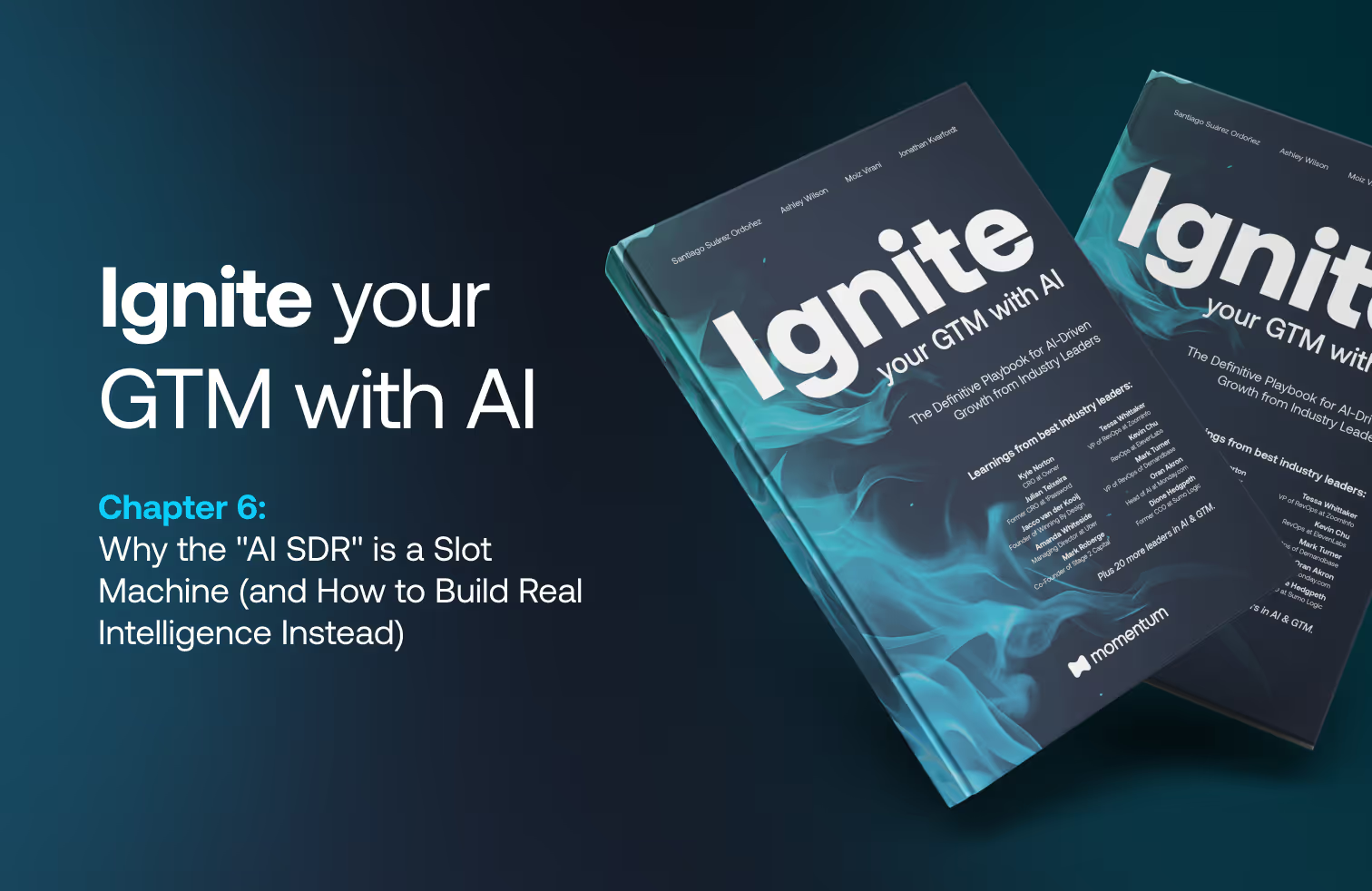

Ignite Your GTM With AI, Chapter 6: Why the "AI SDR" is a Slot Machine (And How to Build Real Intelligence Instead)
Welcome back to our deep dive into "Ignite Your GTM With AI." If you joined us for previous chapters, you know we’ve stripped away the hype to expose the structural shifts happening in the market.
Now, we arrive at Chapter 6: Demand Generation & Personalization at Scale.
This creates a moment of reckoning for most GTM leaders. The promise of the last twelve months was seductive in its simplicity: deploy an AI SDR, feed it your database, and watch your calendar fill up while your humans focus on closing deals. Venture capital poured hundreds of millions into this exact promise.
But if you are reading this, you probably already know the uncomfortable truth. It isn’t working.
In this chapter, featuring insights from Elaine Zelby (Cofounder/CRO at Tofu), John-Henry Scherk (CEO at Growth Plays), and Micael Oliveira (Cofounder/CRO of Amplemarket), we dismantle the "AI SDR" myth and explore the architecture that actually replaces it.
The industry promised you a printing press for qualified leads. Instead, as Micael Oliveira observes with brutal accuracy, the market has become "a slot machine for desperate sales leaders."
The Broken Promise of "Scale"
The seductive premise of the AI SDR was linear economics: "You have an API where you send a dollar and you get more than a dollar back."
The reality has been an inverse correlation between volume and quality. Companies are booking customers based on bold claims, but the technology cannot live up to the expectations set. Most organizations simply used AI to automate the same volume-based approaches that were already failing before the AI acceleration began.
They took a broken process—spamming generic templates to cold lists—and used AI to do it faster and louder. As the chapter notes, this is exactly the "optimization thinking" that the demand generation revolution has revealed to be fundamentally flawed.
The breakdown happens because B2B buying isn't an e-commerce transaction. It involves high-stakes risk. Buyers are "betting their career" on vendor selections. They crave human connection, strategic understanding, and trust. Yet, most AI-powered demand gen tools treat them like static data points to be optimized for conversion friction.
We are currently witnessing a massive gap between expectation and reality. Leaders expected quality at scale; they got industrial-grade noise.
The "Discovery Layer" Has Shifted Beneath Your Feet
While sales teams are busy automating emails, a far more dangerous shift is happening in how buyers actually find you.
The traditional playbook was simple: SEO. You create content, rank for keywords, and capture demand. But that era is ending. Buyers are bypassing search engines entirely.
They are turning to AI-powered answer engines like ChatGPT, Claude, and Perplexity for research and vendor evaluation.
John-Henry Scherk captures this disruption perfectly: "What used to happen in traditional search (where people compared and evaluated options) is now happening inside ChatGPT or similar tools. But here’s the thing: GenAI hasn’t actually created more buyers; it’s just moved where that decision-making happens."
This is a terrifying prospect for traditional content marketing. Your "Top 10 Revenue Intelligence Platforms" blog post doesn't matter if the buyer asks ChatGPT for a recommendation and your company isn't in the synthesized answer.
The AI doesn't just look at your #1 ranked article. It considers dozens of sources, weighing mentions, citations, and contextual references to determine authority.
This demands a shift from "Search Engine Optimization" to Surround Sound Authority.
To survive in an AI-mediated discovery world, you cannot just optimize your own content. You must be unavoidable across the entire ecosystem. When a prospect searches, they should encounter:
- Your content ranking high.
- Industry analyst reports mentioning you.
- Podcast episodes featuring your executives.
- Community forum discussions recommending you.
This is the only way to influence the "training data" that feeds the AI recommendations. The goal is becoming "such a dominant force in that topic... that it'd be weird to not be mentioned."
From "Intent Data" to Causal Signals
Perhaps the most critical architectural shift in Chapter 6 is the death of generic intent data.
For years, we’ve relied on black-box "intent" scores that tell us Company X is interested in our category. But as Elaine Zelby points out, intent is vague. "I don't know what was the intent, how strong was the intent."
Real demand generation requires Signals.
But not just any signals. Jordan Crawford’s warning from Chapter 5 still applies: generic signals (like "job change") are commoditized and worthless.
True intelligence comes from Causal Signals—observable behaviors that indicate a specific situation your product solves.
Elaine gives a brilliant example from Tofu. They don't just track "marketing activity." They track if a company is doing frequent webinars. Why? Not because it’s a generic sign of growth, but because Tofu has a "webinar-in-a-box" product. The behavior (webinars) has a direct causal relationship to the pain point they solve.
This is the difference between "personalization" (inserting {{First_Name}} into a template) and Contextualization.
Contextualization means you understand the situation.
- The Signal: A champion moves to a company that is currently moving upmarket.
- The Inference: They are likely looking to mature their ABM strategy.
- The Outreach: "I see you've moved to [Company], and noticed the push into enterprise. Typically that breaks [Process X]..."
This approach creates "permissionless value." You are bringing insights to the table that the prospect would essentially pay to receive. You aren't asking for time; you are delivering intelligence.
The Four Dimensions of Intelligence Architecture
Chapter 6 outlines the new "Intelligence Architecture" required to execute this at scale. It replaces the linear campaign model with a dynamic system.
1. Context Engineering This transforms AI from a template-filler into an intelligence amplifier. You must architect data models that synthesize behavioral history, persona context, and market conditions. It’s about building confidence intervals—knowing when the AI should act and, crucially, when it should "hand control back to the human."
2. Human-AI Orchestration The most important decision is not if to use AI, but where humans add value. Micael Oliveira uses the "noisy party" analogy: The AI is the noise-canceling headphones that filter the room so the human can have a meaningful conversation. Enterprise accounts require human-led strategy with AI support; SMB might be AI-led with human oversight.
3. Signals Mapping This moves beyond "Company X raised funding." It detects compound patterns: A company modernizing its tech stack + increasing content output + a leadership change. These combinations predict purchasing readiness in a way single data points never can.
4. Transparent Reasoning You cannot improve what you cannot explain. AI systems must provide "Transparent Reasoning"—making decisions explainable and auditable. If an AI agent suggests a prospect, it must explain why based on signal analysis and historical outcomes.
Implementing "Ops Plus Discipline"
So, how do you actually build this?
The chapter argues that success doesn't come from buying a tool, but from developing a new organizational capability called "Ops Plus Discipline."
Elaine Zelby suggests a practical approach to building this muscle: The Hackathon Solution. Give your team permission to stop regular work for four hours. Their only goal? "Build something that's going to save you 400 hours in the future."
This forces non-technical teams to engage with the logic of their work. They have to articulate how they research a prospect before they can automate it. It turns your team from tool-users into system-architects.
Why Momentum Is The Architecture You Are Missing
If you read Chapter 6 carefully, you will realize that the barrier to this new world isn't "AI capability." The AI models exist. The data exists.
The barrier is Orchestration.
Most companies cannot execute "Contextualization at Scale" because their data is trapped in silos. The signal (champion job change) happens in LinkedIn. The context (past usage data) sits in Snowflake or Pendo. The execution (email sequence) happens in Outreach. The intelligence (CRM data) sits in Salesforce.
These systems do not talk to each other. You cannot build "Compound Signals" when your data is disconnected.
This is why we built Momentum.
Momentum is the Intelligence Architecture that Chapter 6 describes. We are the connective tissue that turns disconnected tools into a living intelligence system.
- Signals Mapping: Momentum detects the "intelligence-driven signals" described in this chapter—whether it's a champion moving, a pricing page visit, or a usage spike—and captures them instantly.
- Context Engineering: We don't just alert you. We synthesize the data. Momentum pulls the relevant context—who this person is, their past history with you, their company's current tech stack—and structures it for action.
- Human-AI Orchestration: We route that intelligence to the right place. Maybe it triggers an autonomous AI agent for a low-tier prospect. Maybe it creates a high-priority Slack alert for your Enterprise AE with a drafted, context-rich message ready for human review.
The chapter warns: "You cannot systematize precision you haven't achieved." But once you have achieved that precision manually, Momentum is the only platform designed to scale it without losing the human nuance.
You can continue treating demand generation like a slot machine, pulling the lever and hoping for leads. Or you can build an engine.
Ready to stop playing the odds and start architecting revenue? Book a demo with Momentum today.
Stay tuned for our breakdown of Chapter 7, where we will dive into the new physics of the sales pipeline.