


.svg)


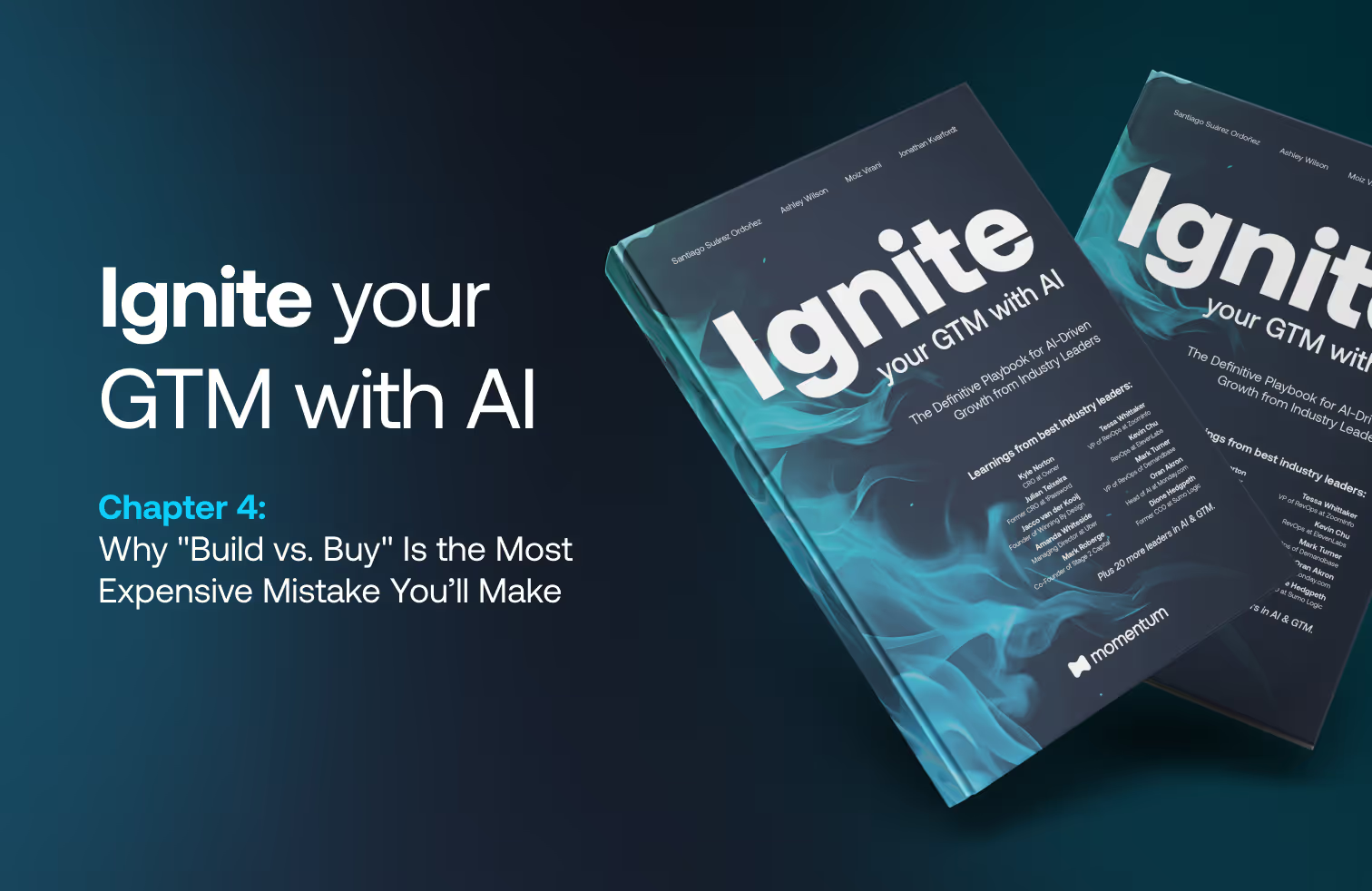

Welcome back to our deep-dive series into "Ignite Your GTM With AI."
If you read our breakdown of Chapter 1, you know the landscape has shifted. You understand that we are moving from a world of tools to a world of architecture. But as GTM leaders and engineers sit down to execute this new reality, they almost immediately hit a wall.
It manifests in a single question that dominates every leadership meeting, slack channel, and budget review:
"Should we build our own AI solution, or should we buy one?"
On the surface, it seems like a practical procurement question. You compare the cost of a vendor license against the salaries of your engineering team. You look at feature lists. You estimate time-to-value.
But in Chapter 4, "Build vs. Buy: The Great Debate for GTM Engineers," we reveal that this binary framing is the fastest way to introduce massive technical debt into your organization.
With insights from Brendan Short (Founder of The Signal) and Elio Narciso (Cofounder & CEO at ScaleStack), this chapter dismantles the traditional procurement mindset.
The leaders winning in 2025 aren't choosing between building and buying. They are doing something entirely different. They are treating AI capabilities not as isolated software purchases, but as components of a living "Intelligence Architecture."
The Hidden Trap of the "Build"
The instinct to build is strong, especially for technical teams. "We have the engineers," you think. "We can just wrap the OpenAI API, ingest our CRM data, and create a custom lead scoring model in a few weeks."
It sounds efficient. It sounds like you are retaining control.
But as Chapter 4 details, writing the first line of code for an AI system represents perhaps 5% of the total effort required.
The hidden complexity lies in what comes next. When you build an internal AI tool, you are not just writing a script. You are birthing a product.
That internal lead scoring model is now a product that requires a product manager. It requires user support for when sales reps don't understand the output. It requires evaluation frameworks to ensure it isn't hallucinating. Most critically, it requires constant maintenance as the underlying models shift.
We are in an era where model capabilities change monthly. The prompt engineering that worked for GPT-4 might be obsolete or inefficient for GPT-5 (or Claude 3.5 Sonnet). If you build internally, your team is on the hook to re-optimize your entire stack every time the foundation model providers drop an update.
As Brendan Short puts it: "It's not that your team can't build these things. It's just a question of whether that's the best use of their time."
The cost isn't just the salaries; it's the opportunity cost. Every hour your best engineers spend patching an internal orchestration tool is an hour they aren't building core product differentiation.
The Danger of the "Buy"
So, the answer is to buy, right? Let the vendors handle the complexity.
Not quite. Buying has become equally treacherous.
Traditional vendor relationships are built around stable software with predictable roadmaps. You buy a CRM, you know what it does today, and you know what it will do in three years.
AI capabilities are different. They are fluid. A vendor solution that works perfectly for your specific use case today might become obsolete in six months if the vendor fails to keep pace with the latest model capabilities. Or, just as likely, the vendor might pivot their strategy to chase a broader market, leaving your specific context behind.
Furthermore, traditional SaaS vendors often force you into their workflow. They have rigid ideas about how data should flow and how decisions should be made. In the era of Intelligence Architecture, where differentiation comes from unique orchestration of data and logic, a rigid vendor tool is a straightjacket.
Elio Narciso points out the risk of vendor misalignment: "You need vendors who are willing to work with the enterprise to understand the context and the other workflows, because otherwise it will fail."
If you buy a "black box" solution, you surrender control over your intelligence. You get a score or a recommendation, but you don't know why. You can't tune it. You can't audit it. You are dependent on a third party for your competitive brainpower.
The New Lens: Intelligence Architecture
If building creates a maintenance nightmare and buying creates a dependency trap, what is the alternative?
Chapter 4 introduces a new lens: Intelligence Architecture.
This approach rejects the binary choice. Instead, it asks: "How will this capability integrate into our overall system, and which approach enables that integration?"
Successful organizations are adopting a hybrid pattern. They architect systems that combine best-in-class vendor solutions (for foundational capabilities like data enrichment or transcription) with internal logic (for strategic decision-making and differentiation).
They don't buy "solutions"; they buy "capabilities" that they can orchestrate. They don't build "platforms"; they build "glue" that holds the system together.
To navigate this, the chapter outlines four critical dimensions you must evaluate before making any decision.
1. Context Engineering
The foundation of any AI decision must be your data reality.
Elio shares a story about working with Redis. They had 270,000 accounts in their CRM, but 40% of them had data hygiene issues. In a sample of 10 accounts, 6 had incorrect attributes.
If you throw a "bought" AI vendor at that mess, you just get faster, automated bad decisions. If you "build" a model on top of that mess, you spend months debugging why your predictions are wrong.
The architectural question is: Can this solution support the data hygiene and context engineering we need?
- Internal Builds: Give you control over data consolidation, but force you to maintain the pipelines.
- Vendor Solutions: Can accelerate data cleaning (if that's their specialty) but often impose rigid data models.
The winner is usually a hybrid: Use a vendor to clean and enrich the data (Context Engineering), but use your internal architecture to decide how that data is interpreted.
2. Human-AI Orchestration
We established in earlier chapters that the goal is not full automation, but "Human-AI Orchestration." You want AI to handle the drudgery (research, categorization) and humans to handle the judgment (strategy, relationships).
When evaluating Build vs. Buy, you must ask: Does this solution allow for complex handoffs?
Most "bought" tools have basic routing: "If deal size is > $10k, assign to Human."
But your business logic is likely more complex. You might want to route based on relationship strength, previous interaction history, or recent news signals.
Brendan Short notes: "I don't think the last mile has to be fully automated... But for high ACV deals, it makes sense to not fully automate, but to build that logic into these workflows."
If a vendor tool forces a "fully automated" or "fully manual" binary, it breaks your orchestration. You need an architecture that allows you to insert human judgment exactly where it matters.
3. Signals Mapping
Old-school marketing automation tracks static events: email opens, page clicks, form fills. Intelligence Architecture tracks signals: behavioral patterns that predict outcomes.
A "signal" might be: A stakeholder from a target account visited your technical docs, while a finance persona from the same account viewed your pricing page on the same day.
That is a complex signal indicating a buying committee is forming.
- Buy: Most off-the-shelf vendors cannot detect that specific cross-persona pattern without heavy customization.
- Build: You can write a script to detect it, but you have to maintain the integrations with three different data sources to catch it.
The architectural approach looks for vendors that provide the raw signal data, but allows you to build the logic that interprets that signal as a buying opportunity.
4. Transparent Reasoning
This is the sleeper issue that kills AI adoption. If an AI tells a sales rep "Call this lead," and the rep asks "Why?", and the system cannot answer, the rep will ignore it.
AI must move from a probabilistic black box to a deterministic partner. It must show its work.
- Buy: Many vendors treat their algorithms as IP. They won't tell you why a score is a 78/100.
- Build: You can force transparency, but you have to build the UI and the logging infrastructure to display it.
You need an architecture that prioritizes auditability. If you can't trace the decision back to the input data, you shouldn't use it.
Practitioner Models: How the Pros Do It
Chapter 4 highlights two distinct approaches from our contributors that prove you don't have to choose between "all-in build" or "all-in buy."
The High-Touch Partnership (Elio Narciso) Elio advocates for treating vendors as development partners. At ScaleStack, they don't just hand over a login; they work with the enterprise to map their specific context. This model works well for organizations that need deep customization but lack the internal engineering bandwidth to maintain it. The vendor essentially becomes an extension of your engineering team, absorbing the "maintenance tax" while you retain strategic input.
The Architectural Assembly (Brendan Short) Brendan’s approach is about composability. He doesn't buy a monolith. He buys components. He uses Clay for data orchestration. He uses various APIs for enrichment. He uses OpenAI for content generation. But here is the key: He builds the orchestration layer. He owns the logic that connects these pieces. This gives him the flexibility of an internal build (he can swap out Clay for another tool if needed) with the power of best-in-class vendors. "I think the playbook of old is dying very fast," Brendan says. "The companies figuring out how to use AI are getting massive leverage."
The "Maintenance Trap" vs. The "Lock-in Trap"
The chapter concludes with a warning about the two cliffs on either side of this road.
The Maintenance Trap: You decide to build a "Territory Assignment Platform." It works great for three months. Then the sales team wants a new feature. Then the API it relies on changes version. Suddenly, you are spending $2M a year on engineering time for an internal tool that has nothing to do with your customer-facing product.
The Vendor Dependency Trap: You buy a comprehensive "AI Sales Platform." It creates a proprietary data format. Two years later, a new model comes out that changes the game, but your vendor is slow to adopt it. You are stuck with 2023 technology in a 2025 world because moving your data out is impossible.
The only way to avoid both traps is to decouple your Business Logic from your Capabilities.
You should buy the capabilities (the LLMs, the data enrichment, the transcription). These are commodities that will get cheaper and better. You should own the business logic (the prompts, the routing rules, the signal definitions). This is your differentiation.
Momentum: The Architecture for the Hybrid World
This brings us to the role of Momentum.
When you look at the insights from Chapter 4, you realize that the market is missing a layer.
Companies have plenty of "Capabilities" (Salesforce, OpenAI, Clay, Gong). Companies have plenty of "Business Logic" (their unique sales process, their ICP definitions).
What they lack is the Infrastructure to connect them without writing custom code.
Momentum is that infrastructure. We are the solution to the Build vs. Buy debate because we allow you to do both simultaneously.
We solve the Maintenance Trap. With Momentum, you "build" your workflows and AI agents using no-code/low-code architecture. You define the logic: "If a signal comes from Gong AND a signal comes from the Product, THEN trigger this AI agent." Because it is built on Momentum, you don't have to maintain the API connections. We handle the "plumbing" updates. You don't need a product manager for your internal tool; you just need an operations leader who understands the business.
We solve the Vendor Dependency Trap. Momentum sits above your stack. We integrate with Salesforce, HubSpot, Slack, Gong, OpenAI, Anthropic, and dozens of others. If you want to swap your data enrichment provider from Clearbit to ZoomInfo? You change a node in Momentum. You don't have to rebuild your entire system. If you want to switch your underlying model from GPT-4 to Claude? You just update the prompt configuration in Momentum.
We enable Architectural Assembly. Just like Brendan Short describes, Momentum allows you to assemble best-in-class components. You can pull data from your warehouse, process it with an LLM, and push the result to Slack—all orchestrated by Momentum. You own the logic (the "Build" benefit) but leverage external power (the "Buy" benefit).
We ensure Transparent Reasoning. Every action taken by a Momentum workflow is logged and auditable. You can see exactly why a lead was routed, what data was used to score it, and what the AI output looked like before it was sent.
Stop Choosing. Start Architecting.
The leaders who will dominate the next few years won't be the ones who built the best internal chatbot, nor the ones who bought the most expensive enterprise license.
They will be the ones who architected a system where internal logic and external power flow seamlessly together. They will be the ones who realized that "Build vs. Buy" is a false choice.
The real choice is: Architecture vs. Chaos.
If you are ready to stop debating procurement and start building an Intelligence Architecture that evolves as fast as the market, you need to see Momentum in action.
We can show you how to build the orchestration layer that turns your disconnected tools into a coherent revenue engine.
Get your copy of "Ignite Your GTM With AI" to read the full chapter and dive deeper into the frameworks used by Elio and Brendan.