


.svg)


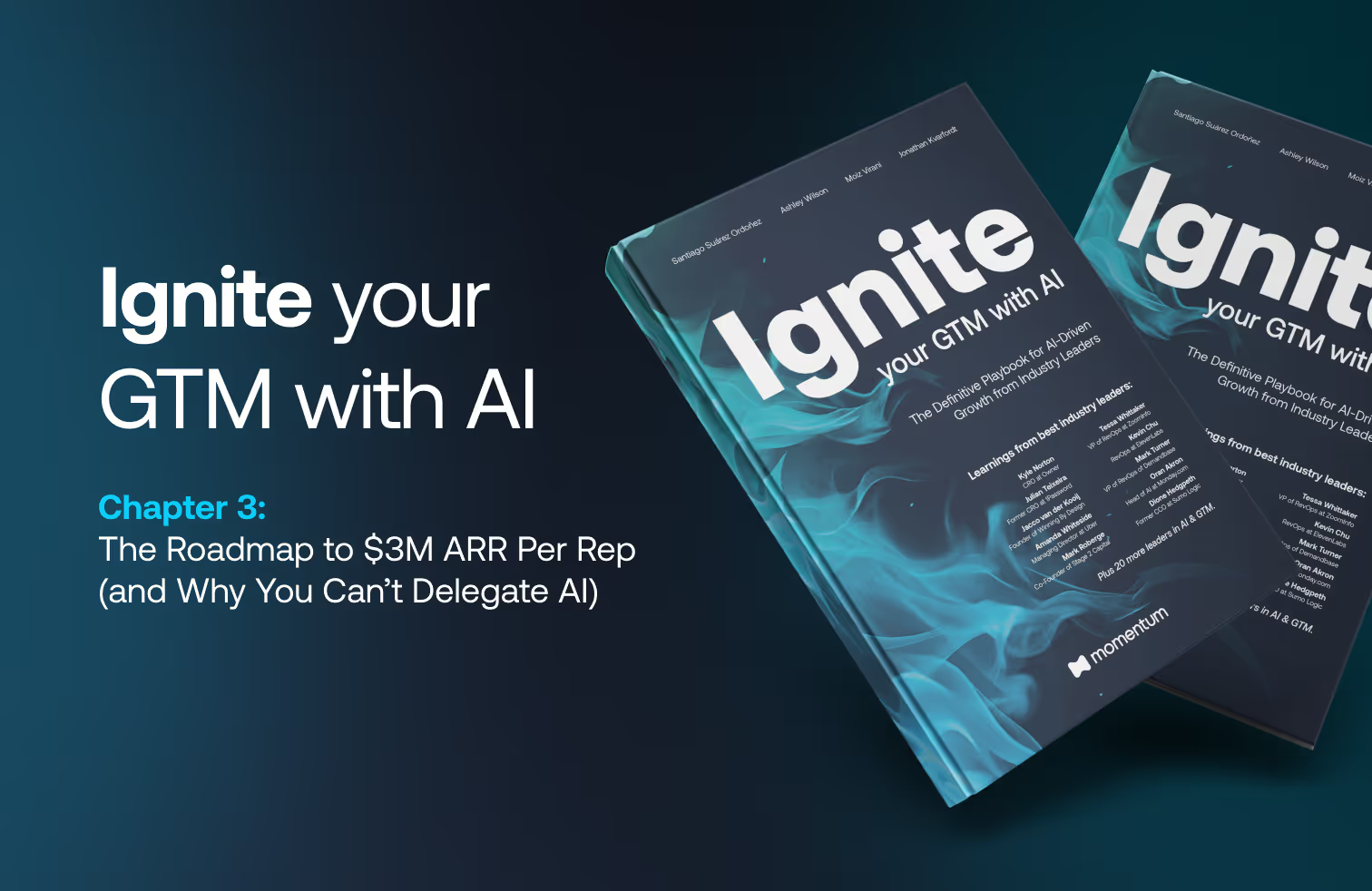

Welcome back to our series dissecting "Ignite Your GTM With AI." In Chapter 1, we explored the "why" and the landscape of 2025. In Chapter 2, we looked at the strategy. Now, in Chapter 3, "A Strategic Roadmap for AI Transformation," we hit the ground running with the "how."
If the previous chapters were the blueprints, this is the construction manual.
And to help us write it, we brought in a heavy hitter: Kyle Norton, CRO at Owner.
Kyle hasn’t just theorized about AI; he has built AI-native go-to-market operations that are delivering results most revenue leaders would consider a typo. His teams consistently deliver what he describes as "sometimes 3 million ARR per rep per year" in SMB segments.
Let that sink in.
We aren't talking about a 20% efficiency bump. As Kyle puts it, "The sales acceleration era maybe got you like 50% leverage or 2X leverage... But going all the way to fully utilizing the benefits of AI could be like 10X leverage on a sales rep."
But getting to that 10X leverage requires navigating a minefield of distractions, bad data, and organizational inertia. In Chapter 3, we detail the roadmap to get there.
Here is the truth about why most companies are stuck in "pilot purgatory" and how the top 1% are building Intelligence Architectures that scale.
The Transformation Trap: Why Delegation is Failure
The single biggest takeaway from Kyle’s experience is a hard pill for many executives to swallow: AI transformation cannot be delegated.
In the past, you could buy a CRM, hand it to your RevOps team or an IT consultant, and tell them to "roll it out." You checked in at the QBR, and life went on.
Intelligence Architecture is different. It requires direct leadership engagement with the technology itself.
Kyle identifies a dangerous phenomenon called the "transformation trap." This is the tension where moving too slowly guarantees obsolescence, but moving too fast without understanding the tech leads to expensive, embarrassing failures.
Most executives try to solve this by hiring consultants or delegating to a "Head of AI." But Kyle is adamant: "Every leader has to be in the tools. If you're not touching the tech, you won't understand its strengths or its limitations."
To make architectural decisions—to decide how your company actually thinks and processes information—you must have a firsthand understanding of what the models can and cannot do.
The Shift: From Tool Adoption to Intelligence Architecture
The reason Kyle’s reps are hitting $3M ARR isn't because they type faster or have better email templates. It’s because he has fundamentally reimagined the "basic unit of sales work."
The Old Way: Cognitive Overhead
Think about what happens after a typical prospect call. An Account Executive hangs up and then spends 20 minutes updating Salesforce, decoding their scribbled notes, writing a follow-up email, and slacking the product team about a feature request.
This "post-call administration" consumes hours of selling time every single day. It drains the rep's cognitive battery, leaving them with little energy for actual relationship building.
The New Way: Zero Overhead
Kyle’s approach utilizes Intelligence Architecture to eliminate this cognitive overhead entirely.
In an AI-native operation, systems automatically process the call transcript. They identify objections, flag competitor mentions, extract key themes, generate summaries, and queue up the next actions.
The result? The Account Executive focuses exclusively on the strategic conversation.
This is the distinction between "Traditional Tool Deployment" and "Intelligence Architecture."
- Traditional: You buy a tool to make data entry 10% faster.
- Architecture: You design a system where the data entry disappears.
When you remove the constraints of human information processing, entirely new organizational structures become possible.
The Four Dimensions of Action
Chapter 3 doesn't just preach philosophy; it provides a framework. To replicate the success at Owner.com, you must master four critical dimensions.
1. Context Engineering (Fix Your Data Foundations)
You have heard "garbage in, garbage out" a million times. But in the age of LLMs, it’s more like "garbage in, confident hallucination out."
Kyle’s experience reveals that technical architecture is only as effective as the data infrastructure supporting it. He calls this "Context Engineering."
The mistake most companies make is starting with the cool stuff—the automated emails or the chatbots. But Kyle warns: "If you are at a data deficit today, then everything is going to be excruciatingly painful and just don't bother doing anything else until you fix this."
You need Structured + Unstructured Integration. You must move beyond human-centric dashboards. You need data pipelines that connect the rich, unstructured context of sales calls and emails directly to the structured fields in your CRM.
2. Human-AI Orchestration (The 70/20/10 Rule)
Who actually builds this? Do you fire your Ops team and hire prompt engineers?
Kyle suggests a specific staffing ratio for AI transformation, which he calls the 70/20/10 rule:
- 70% Internal Capability: Your existing RevOps and DataOps teams must level up. You cannot silo AI knowledge; it must be distributed.
- 20% Hired Expertise: You need a "true subject matter expert" to lead the architecture. Someone who can design the multi-step workflows (e.g., a button in Salesforce that triggers a scraper, maps customers, and writes notes).
- 10% Consultants: Use them sparingly. "I don't think you can hire a consultant to be my AI transformation consultant and figure it all out because they won't know your business well enough."
3. Signals Mapping (The 4P Framework)
Once you have the team and the data, how do you pick what to build? Leaders are bombarded with "cool" tools every day.
To cut through the noise, Kyle uses the 4P Framework to evaluate use cases:
- Possibilities: What outcome could this enable?
- Payoff: How big is the business impact?
- Probability: Can we actually pull this off given our current data?
- Perspiration: How hard is the change management?
He advises prioritizing areas where AI naturally excels: Synthesis and Analysis (digesting huge amounts of info), Research, and Ideation.
4. Transparent Reasoning
The final dimension is trust. If an AI tells you to forecast a deal at 90%, you need to know why.
Transparent reasoning means architecting systems that explain their work. It’s about treating AI as a "sparring partner," not a teacher.
Kyle uses the analogy of having "10 of the world's smartest interns." You wouldn't toss them a pile of data and say "tell me what to do." You would give them specific, structured tasks and ask them to show their math. Your AI architecture must function the same way.
The 90-Day Foundation Sprint
If you try to boil the ocean, you will fail. The book outlines a specific 90-Day Foundation Sprint to get "small wins first in the bag."
Here is the condensed version of the timeline detailed in Chapter 3:
Days 1-30: The Data Cleanup
Stop looking at AI tools. Look at your plumbing.
- Data Flow Mapping: Where does info live? Who has access?
- Integration Audit: Do your systems talk to each other? (e.g., does your call recording platform update the CRM?).
- Quick Wins: Implement the obvious integrations that are currently broken.
Days 31-60: The "Hands-On" Phase
This is where the culture shifts.
- Leadership Immersion: The CRO and VP of Sales must spend two hours daily using AI tools personally. This is non-negotiable.
- Capability Assessment: Figure out who on your team has the "technical curiosity" to become an architect.
Days 61-90: The First Pilots
Now, you build.
- Select Use Cases: Apply the 4P framework. Look for high-payoff, low-perspiration projects.
- Pilot: Common hits include automated CRM entry from calls or AI-generated account research.
- Measure: Document the time saved and accuracy gained.
Failure Patterns: Where Companies Crash
Chapter 3 is candid about where this goes wrong. Kyle outlines several "Failure Patterns" that we see constantly in the market.
The most common is Tool-First Implementation. Companies see a demo, get excited, and buy the tool hoping for magic. But because they skipped the "Context Engineering" phase, the tool has no good data to work with. It fails, and the organization decides "AI isn't ready yet."
Another killer is Delegation Without Understanding. We mentioned this earlier, but it bears repeating. If your strategy is "I told the Ops guy to figure out AI," you have already lost.
Momentum: The Context Engine for Your Transformation
Reading Chapter 3 leads to an inevitable question: How do I actually build this infrastructure without hiring an army of engineers?
You need to fix your data foundations. You need to connect unstructured signals (calls, emails) to structured records (CRM). You need to orchestrate workflows that remove cognitive overhead.
This is exactly what Momentum was designed to do.
Momentum is the Context Engineering layer Kyle describes.
- We Solve the Data Foundation: Kyle warns that if you have a "data deficit," you are stuck. Momentum automatically captures and structures data from your sales calls, emails, and Slack channels, pushing clean, validated data into Salesforce. We turn "unstructured context" into "structured assets."
- We Enable the Workflow: The book describes a "post-call" world where AI updates records and queues actions. That is literally our core functionality. Momentum digests the call, updates the deal fields, summarizes the next steps, and hands the rep a "ready-to-go" action plan.
- We Are the Orchestration Layer: Kyle talks about the need for "multi-step, cross-tool workflows." Momentum sits between your tools—Salesforce, Gong, Slack, Outreach—and orchestrates the flow of intelligence between them.
When Kyle says, "design intelligent workflows where AI automatically researches prospects... and updates CRM records," he is describing the Momentum architecture.
We allow you to implement the Intelligence Architecture approach without needing to build a custom engineering team to do it.
Your Next Step
The difference between a rep managing $500k ARR and $3M ARR isn't talent; it's the system surrounding them.
If you are ready to stop drowning in "tool fatigue" and start building an architecture that compounds revenue, you need to read this full chapter. It breaks down the 70/20/10 rule and the 90-Day Sprint in granular detail.
But if you want to start the 90-Day Foundation Sprint today—specifically the "Quick Integration Wins" and "Data Quality Cleanup"—we can help you skip the manual labor.
Get the book "Ignite Your GTM With AI" to see the full blueprint.
And if you’re ready to implement the architecture, book a demo with Momentum and let us show you how we automate the cognitive overhead.