


.svg)


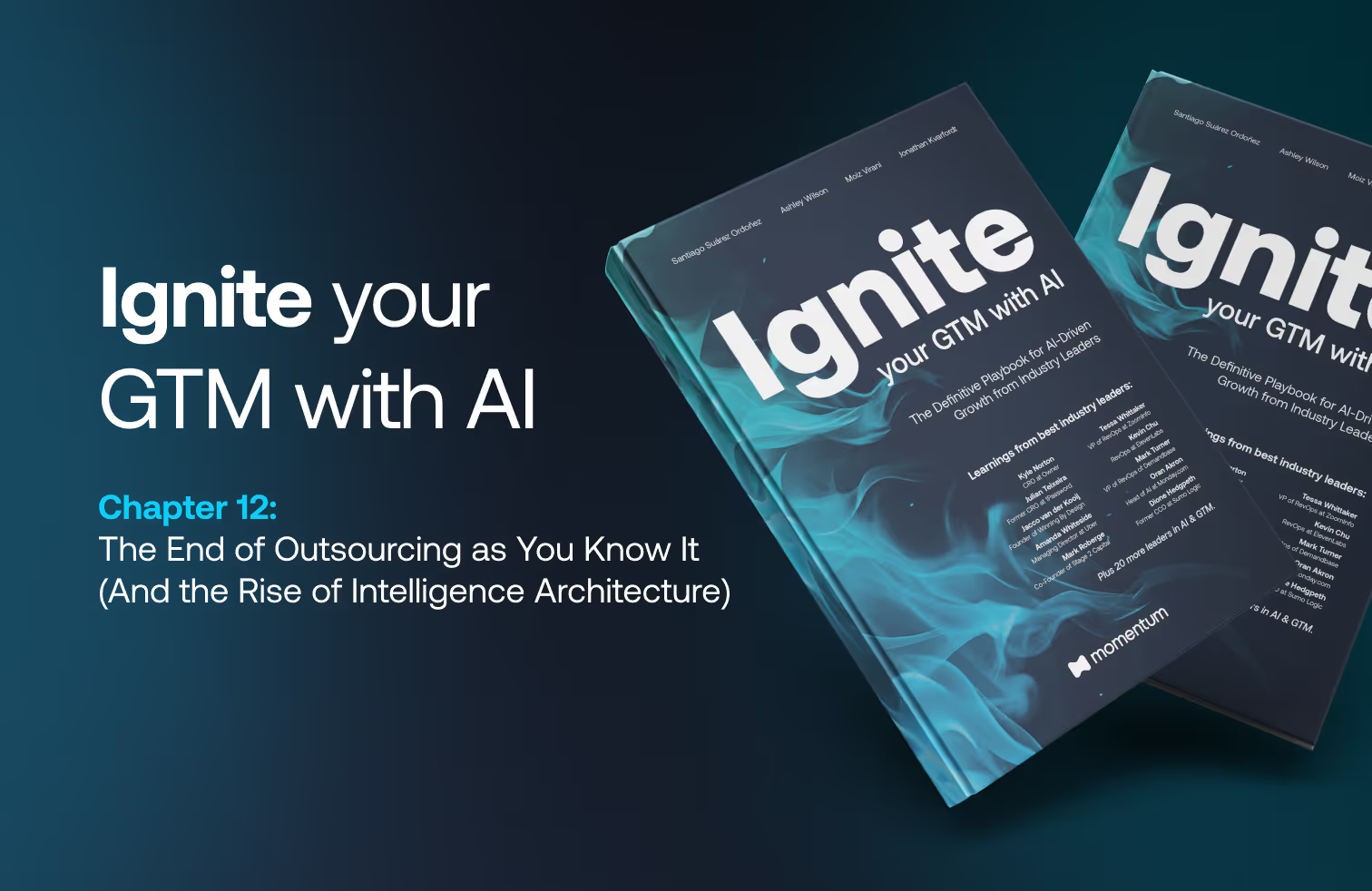

Welcome back to our deep dive into "Ignite Your GTM With AI." We have traversed the landscape of sales, marketing, and customer success. Now, in Chapter 12, we arrive at the operational backbone that supports them all: the workforce itself.
This chapter tackles the subject that keeps every knowledge worker up at night. We are talking about displacement anxiety. We are talking about the fundamental restructuring of how work gets done.
To explore this, we partnered with Seth Stover, CEO of Tiderise. Seth has built an ethical, AI-enabled outsourcing firm from the ground up, and his insights dismantle the traditional view of labor arbitrage.
For decades, the outsourcing playbook was simple: find repeatable tasks, document them poorly, and ship them to a lower-cost geography. It was a game of "mess for less."
That game is over.
In Chapter 12, "AI-Enabled Outsourcing & Talent: Architecting the Future Workforce," we explore why the arrival of AI doesn't mean the end of human outsourcing. Instead, it demands a radical evolution from simple cost savings to Intelligence Architecture.
The Existential Crisis of Knowledge Work
The chapter opens with uncomfortable data. In 2024, Microsoft researchers analyzed 200,000 interactions between users and AI systems. They mapped these against occupational databases to measure the overlap between human work and AI capabilities.
The results were stark. Interpreters showed a 98% task overlap. Historians showed 91%. Writers, 85%.
Crucially, this disruption is not coming for physical labor first. Nursing assistants and equipment operators showed minimal overlap. AI is coming for the complex knowledge work—research, analysis, and communication—that organizations traditionally viewed as safe harbors for human judgment.
This creates a paradox. Companies face a workforce anxious about their relevance while simultaneously needing to integrate systems that could eliminate roles.
Most organizations react with two failing strategies. They either treat AI and outsourcing as competitors (automate what you can, outsource what you can’t), or they simply bolt AI tools onto existing, inefficient outsourcing relationships.
Both approaches miss the point. AI is not a replacement for outsourcing; it is its fundamental disruptor. The companies thriving in this new reality are moving beyond process optimization. They are designing Intelligence Architectures where internal teams, external talent, and AI systems operate as a single, orchestrated organism.
From Cost Arbitrage to Capacity Architecture
The core thesis of Chapter 12 is that we must abandon the "Cost Arbitrage" mindset.
Traditional outsourcing focused on doing the same work for less money. Intelligence Architecture focuses on Capacity Measures. It asks: How do we expand organizational capacity by freeing internal teams to operate at their absolute highest value?
This requires a shift in how we view documentation. In the old world, you created minimal documentation to transfer a task. It was a "handoff."
In the new world, explained by Seth Stover, we move to Knowledge Base Creation. Documentation is no longer a chore; it is an asset. When you document a process for an outsourced team today, you are structuring data for the AI model that will likely automate that task tomorrow.
This creates a "Great Level Up." AI handles the lower-trust execution. Outsourced talent handles the high-trust execution that is too complex for current AI. And your internal teams focus purely on strategy and relationship building.
The Four Dimensions of Intelligence Architecture
Chapter 12 breaks down this transformation into four actionable dimensions. These are the pillars you need to build to survive the transition.
1. Context Engineering: The Video-to-SOP Pipeline
The biggest failure point in outsourcing has always been context. You hire a brilliant person halfway around the world, but they fail because they lack the tribal knowledge sitting in your head.
Seth’s team at Tiderise solved this through Context Engineering. They realized that humans are terrible at writing Standard Operating Procedures (SOPs) but great at doing the work.
Their workflow is revolutionary in its simplicity. They ask clients to simply record a video of themselves doing the work. That’s it.
From there, a multi-pass AI system takes over:
- Pass 1: AI watches the video and extracts the task sequence.
- Pass 2: A second agent drafts the SOP.
- Pass 3: A third agent reviews it for cultural context and logic gaps.
- Pass 4: A human validates it.
This turns the outsourcing process into a knowledge capture engine. Every task you delegate builds the "brain" of your organization, ensuring that when the AI capabilities mature, the training data is already there waiting for it.
2. Human-AI Orchestration: The Trust/Risk Quadrant
How do you decide what to keep in-house, what to outsource, and what to automate? You cannot decide based on "gut feel." You need a framework.
Chapter 12 introduces the Work Segmentation Quadrant, defined by two axes: Trust/Risk (Vertical) and Strategic/Execution (Horizontal).
- Zone 1: High Trust, Strategic (Internal Teams). This is the work that requires deep organizational context and accountability. It cannot be delegated.
- Zone 2: Low Trust, Strategic (AI Augmentation). Creative tasks like initial content generation or research. The risk of error is low, and AI thrives here.
- Zone 3: Low Trust, Execution (Agentic AI). The classic automation zone. Repetitive, low-risk operations.
- Zone 4: High Trust, Execution (Outsourced Talent). This is the sweet spot for the new era of outsourcing. Work that is operational but requires human judgment, nuance, and accountability.
The magic happens when these zones interact. A sales rep (Zone 1) holds a meeting. AI (Zone 3) captures the notes and action items. An outsourced quality specialist (Zone 4) reviews the CRM entry to ensure accuracy and chases the follow-up. The result is a seamless workflow where no one is competing for the same task.
3. Signals Mapping: Beyond Utilization Rates
Traditional outsourcing is managed by timesheets. Did the person work 40 hours?
Intelligence Architecture is managed by Signals.
We need to monitor the health of the entire system. This involves "AI Readiness Indicators"—continuously assessing which processes are becoming standardized enough for automation. It involves "Cultural Integration Signals," using AI to bridge communication gaps between global teams in real-time.
Seth describes using custom AI programs that act as one-to-one coaches for team members in emerging markets, helping them decode the cultural nuances of their Western counterparts. This isn't just about efficiency; it's about dignity and connection.
4. Transparent Reasoning
Finally, decisions must be explicit. In the past, outsourcing decisions were opaque, often driven by hidden budget cuts. In an Intelligence Architecture, every decision—to automate, to outsource, or to insource—is backed by data.
This transparency builds trust. Internal employees are less likely to fear displacement when they can see the logic: "We are automating X so you can focus on Y."
The Historical Optimism
It is easy to read this chapter and feel the weight of the disruption. But the chapter argues for optimism.
We look back at the telephone operators of the 1950s. They manually connected calls via switchboards. Automation destroyed those jobs. But the same technology created entirely new categories of work: videographers, UX designers, social media managers.
We stand in the same position today. We cannot yet conceive of the jobs that will exist in ten years. But we know that by building the infrastructure today—by architecting the collaboration between humans and machines—we are preparing for that future.
The 5-Step Implementation Guide
Chapter 12 concludes with a rigorous 5-step guide to transforming your workforce strategy. We won't give it all away here, but it starts with a Human-AI Orchestration Audit.
You must stop tracking time and start tracking "cognitive load." Ask your team to log activities not by hours, but by complexity and risk. You will likely find 15-20 hours per person per week of cognitive work that does not require their highest-value capabilities.
That is your starting point. That is where you begin to build the architecture.
Momentum: The Infrastructure for Your Intelligence Architecture
You might be thinking, "This architecture sounds incredible, but how do I actually build the plumbing for it?"
You cannot build Intelligence Architecture on top of spreadsheets and fragmented point solutions. You need a layer that captures context, orchestrates signals, and automates the flow of information.
This is why we built Momentum.
Momentum is the operating system for the Intelligence Architecture described in this chapter. We provide the technical rails that allow you to execute the strategies Seth Stover advocates.
We Automate Context Engineering: Momentum captures the "soft data" from your sales and customer success interactions—calls, emails, Slack messages—and structures it automatically. You don't need to force your team to write SOPs or manually update Salesforce. We capture the reality of the work as it happens, creating the "Knowledge Base" that Chapter 12 identifies as critical.
We Power the Orchestration Zones: The Work Segmentation Quadrant requires dynamic routing. Momentum allows you to build workflows that route tasks based on signals.
- Is this a low-risk admin task? Momentum updates the CRM automatically (Zone 3).
- Is this a high-risk churn signal? Momentum alerts a human leader immediately (Zone 1).
- Does this require a complex but standardized follow-up? Momentum drafts the content and cues it for your team to review (Zone 2/4).
We Deliver Signals Mapping: Chapter 12 calls for "Performance Intelligence" and "AI Readiness Indicators." Momentum’s workflow automation gives you precisely that visibility. We track not just the outcome of deals, but the process of the work. We show you where the friction is, where the manual load is highest, and where your "High Trust" talent is getting bogged down in "Low Trust" work.
The workforce of the future is not about replacing humans. It is about elevating them. But you cannot elevate them if they are stuck in the mud of administrative operational debt.
It is time to stop viewing outsourcing as a way to cut costs, and start viewing it as a way to architect intelligence.
Ready to architect your future workforce?
- Get your copy of "Ignite Your GTM With AI" today.
- Book a demo with Momentum to see Intelligence Architecture in action.