


.svg)



Why Revenue Orchestration is the New "System of Action"
The modern Go-to-Market (GTM) infrastructure is undergoing a seismic shift, transitioning from a static architecture of record-keeping to a dynamic architecture of orchestration. For two decades, the CRM—typified by Salesforce—stood as the immutable "System of Record." It was a massive repository designed to store data, but the operational reality of 2025 has exposed a critical flaw in this model: systems of record are inherently passive.
They require manual feeding, they do not participate in the execution of work, and they sit apart from the daily communication flow of the revenue team. This disconnect has birthed the "Execution Gap," a phenomenon where strategic intent fails to translate into frontline action, resulting in sales representatives spending a mere 28% of their time actually selling.
The solution to this efficiency crisis lies in the convergence of the System of Record with the "System of Engagement"—primarily Slack. This isn't just about sending notifications. It is about Revenue Orchestration, a technology layer designed to bridge the chasm between Salesforce and Slack, moving from a model of "enforcement" to one of "enablement".
Defining Revenue Orchestration
Revenue Orchestration Platforms (ROP) are not merely notification engines. A true ROP is a system that enables B2B frontline resources to design, execute, capture, analyze, and improve buyer and customer engagement while optimizing productivity.
Unlike legacy tools that rely on humans to bridge the gap between systems, modern orchestration platforms bring the CRM to the user. They capture unstructured signals from chat and email, enforce structured process governance, and perform bi-directional synchronization without ruining the user experience.
The Modern Sales Tech Problem: "Dark Data" and the Swivel Chair
Despite the proliferation of SaaS applications, GTM teams are drowning in tooling yet starving for time.
- The Swivel Chair Workflow: The traditional workflow requires a rep to "swivel" between the communication layer (Slack) and the database layer (Salesforce). Every time a rep leaves their flow of work to update a record, there is a "re-acquisition cost" of attention.
- The Cognitive Load: Fragmented workflows—email sequencing in Outreach, forecasting in Clari, conversation intelligence in Gong—create a massive cognitive load. This fragmentation is the primary driver of the statistic that 72% of a salesperson's week is lost to non-selling activities.
- Dark Data: Without an orchestration layer, Slack becomes a "dark repository." Valuable context shared in a #deal-acme-corp channel is invisible to the forecasting model in Salesforce.
What to Look for in GTM Workflow Automation Tools
When evaluating the top tools for GTM workflow automation across Salesforce and Slack, you must look beyond basic alerts. Use these five criteria to distinguish enterprise-grade orchestration from simple productivity apps.
1. Agentic AI vs. Passive Notification
- What it should do: operate autonomously without waiting for a human trigger. It should "listen" to calls/chats, reason that a risk exists (e.g., pricing objection), and proactively update Salesforce while alerting the manager.
- Why it matters: This moves the system from Level 1 (Passive Notification) to Level 4 (Agentic AI). It removes the human dependency from data entry.
- What to avoid: Tools that only offer one-way broadcast messages (e.g., "Opportunity Closed Won") without the ability to take action.
2. Automated Deal Rooms (Lifecycle Management)
- What it should do: Automatically create a private Slack channel when an Opportunity reaches a specific stage (e.g., Discovery), map the correct stakeholders from Salesforce (AE, SE, Exec Sponsor), and invite them instantly.
- Why it matters: It ensures the right people are in the room from day one and eliminates the friction of manual "slash commands" to spin up collaboration spaces.
- What to avoid: Tools that require manual setup for every deal channel or fail to archive channels (and capture their history) when deals close.
3. Bi-Directional Sync & Real-Time Action
- What it should do: Allow users to update Salesforce fields directly from Slack via rich, interactive messages (Block Kit). Updates should be real-time.
- Why it matters: If a rep has to leave Slack to update a "Next Steps" field, adoption drops. Latency issues (delays of 5-10 minutes) can kill momentum in a high-velocity sales floor.
- What to avoid: Native integrations that act as a "window" into Salesforce but lack the ability to trigger complex, multi-step workflows across systems.
4. "Enterprise Listening" (Signal Capture)
- What it should do: Ingest data from diverse sources—email APIs, calendar feeds, Gong transcripts, and Slack conversations—and parse unstructured text into structured data.
- Why it matters: Data entry should be an output of the work, not an additional task. If "CompetitorX" is mentioned in a call, the system should update the "Competitor" field automatically.
5. Complex Routing & State Awareness
- What it should do: Manage multi-step, multi-stakeholder processes. For example, a discount request triggers a Slack message to the VP; the VP’s approval triggers a write-back to Salesforce and generates a quote PDF.
- Why it matters: This is "State Awareness"—the system knows where the deal is. Simple alert tools often lack the logic to handle branching approval workflows.
Top Tools Breakdown: The 2025 Market Landscape
The following analysis evaluates the leading platforms based on their ability to not just display data, but to automate the complex, human-centric workflows that drive revenue.
1. Momentum
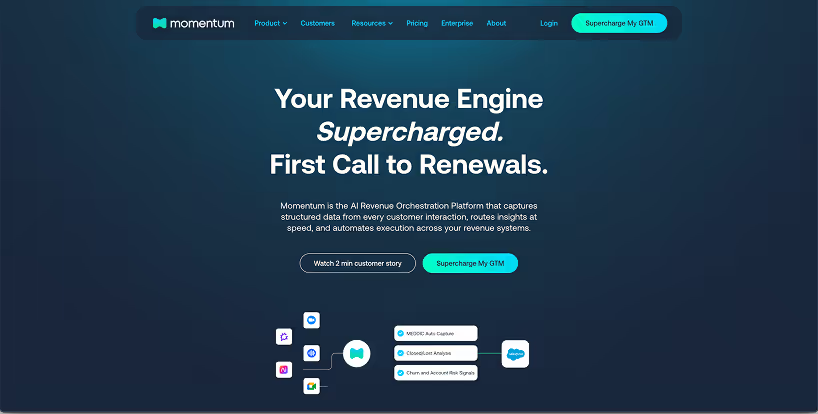
Best for: Enterprise Revenue Orchestration & Agentic AI
Pricing: $69 - $99/user/mo (Business/Transformation); Custom Enterprise pricing.
Key features:
- Agentic AI: Autonomous agents (Deal Execution, Customer Retention) that listen to calls and execute tasks without human triggers.
- Automated Deal Rooms: Auto-creates channels, maps stakeholders, injects context, and archives history back to Salesforce.
- Enterprise Listening: Ingests signals from Gong, Zoom, and Email to auto-update Salesforce fields.
- Approval Workflows: Interactive "Quote-to-Cash" approvals in Slack that reduce cycle times by 50%.
Strengths: Momentum positions itself as a "System of Action". While competitors focus on making humans faster at data entry, Momentum focuses on removing the human from data entry entirely. It creates value by ingesting signals (from Gong/Clari) and acting as the "router" to trigger specific workflows.
Considerations: It is an orchestration hub, designed for the "RevOps Architect" who views GTM as a product to be engineered. It is more than just a productivity tool for individual reps.
2. Rattle
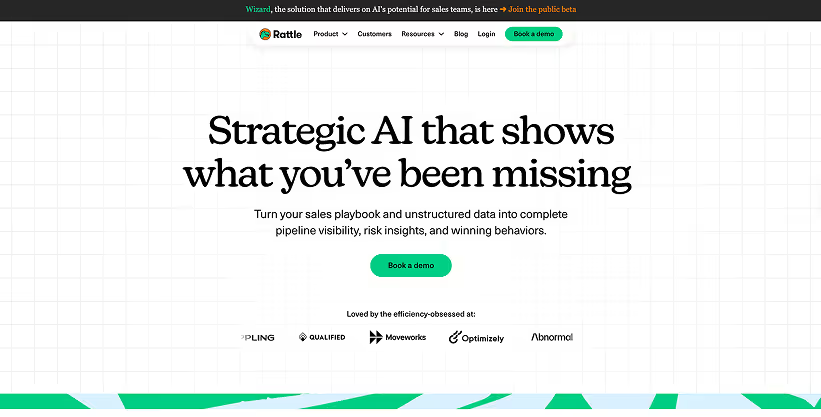
Best for: Process Adherence & Mid-Market Nudging
Pricing: Starts ~$34/user/mo; Tiered (Lightning, Storm, Thunder).
Key features:
- No-Code Workflow Builder: Drag-and-drop interface that allows RevOps to build alerts in minutes.
- Atlas: Visual "heat map" of the revenue funnel that shows where alerts are covering the process.
- Bi-directional Alerts: "If This, Then That" logic that allows reps to update fields from Slack.
Strengths: Rattle acts as the "Guardian" of the sales process. Its ease of use is unbeatable for simple compliance, making it a strong choice for mid-market companies needing a solution up and running in 48 hours.
Considerations: Rattle relies on the "System of Nudges." It depends on the rep taking action. If the rep ignores the alert (Alert Fatigue), the data remains stale. It also lacks the deep "State Management" required for complex enterprise routing compared to Momentum.
3. Slack Sales Elevate
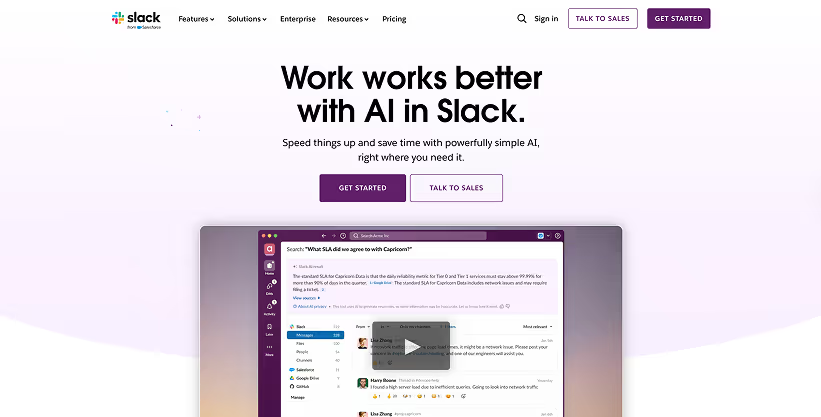
Best for: Native Salesforce "Sales Home" Experience
Pricing: $60/user/month (Add-on).
Key features:
- Sales Home: A persistent dashboard tab inside Slack for viewing open opportunities.
- Inline Editing: Edit opportunity lists directly in the dashboard, mimicking the Salesforce list view.
- Real-time Metrics: Displays KPI progress (e.g., "75% to Quota").
Strengths: The value proposition is simplicity and consolidation. For "Salesforce Shops," it offers a native window into Salesforce without third-party security reviews.
Considerations: High Cost: For an enterprise with 1,000 reps, this is a $720,000 annual add-on. Latency: Alerts can experience delays of 5-10 minutes, which is significant for high-velocity teams. Rigidity: It is an interface (viewing/editing), lacking the sophisticated automation capabilities to auto-create Deal Rooms or run agentic workflows.
4. Scratchpad
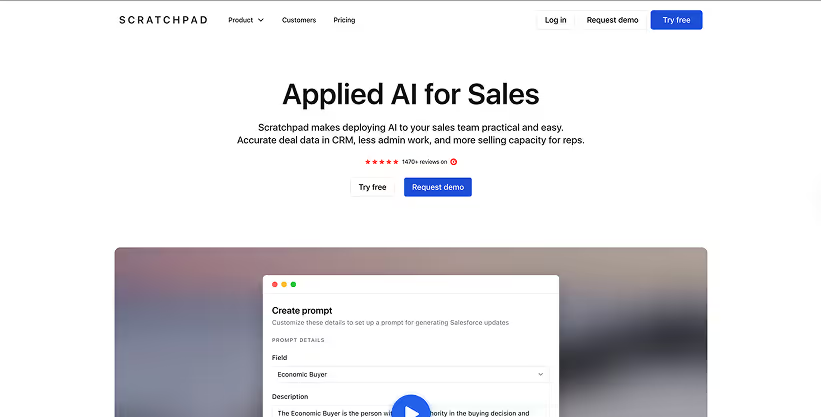
Best for: Individual Rep Productivity (UI Optimization)
Pricing: Freemium; Team ($39/user/mo); Business (Custom).
Key features:
- Grid View: Turns Salesforce into a high-speed spreadsheet overlay.
- Pipeline Updates: Allows bulk edits (e.g., updating 50 opps in 2 minutes).
- Browser Overlay: Focuses on the browser experience rather than moving work primarily into Slack.
Strengths: Reps love Scratchpad because it removes the "click friction" of the Salesforce UI. It is the best tool for improving the "Quality of Life" for the individual seller.
Considerations: It is a productivity tool for the individual, whereas Momentum is an orchestration tool for the organization. It makes data entry faster, but doesn't automate it away.
5. Troopr
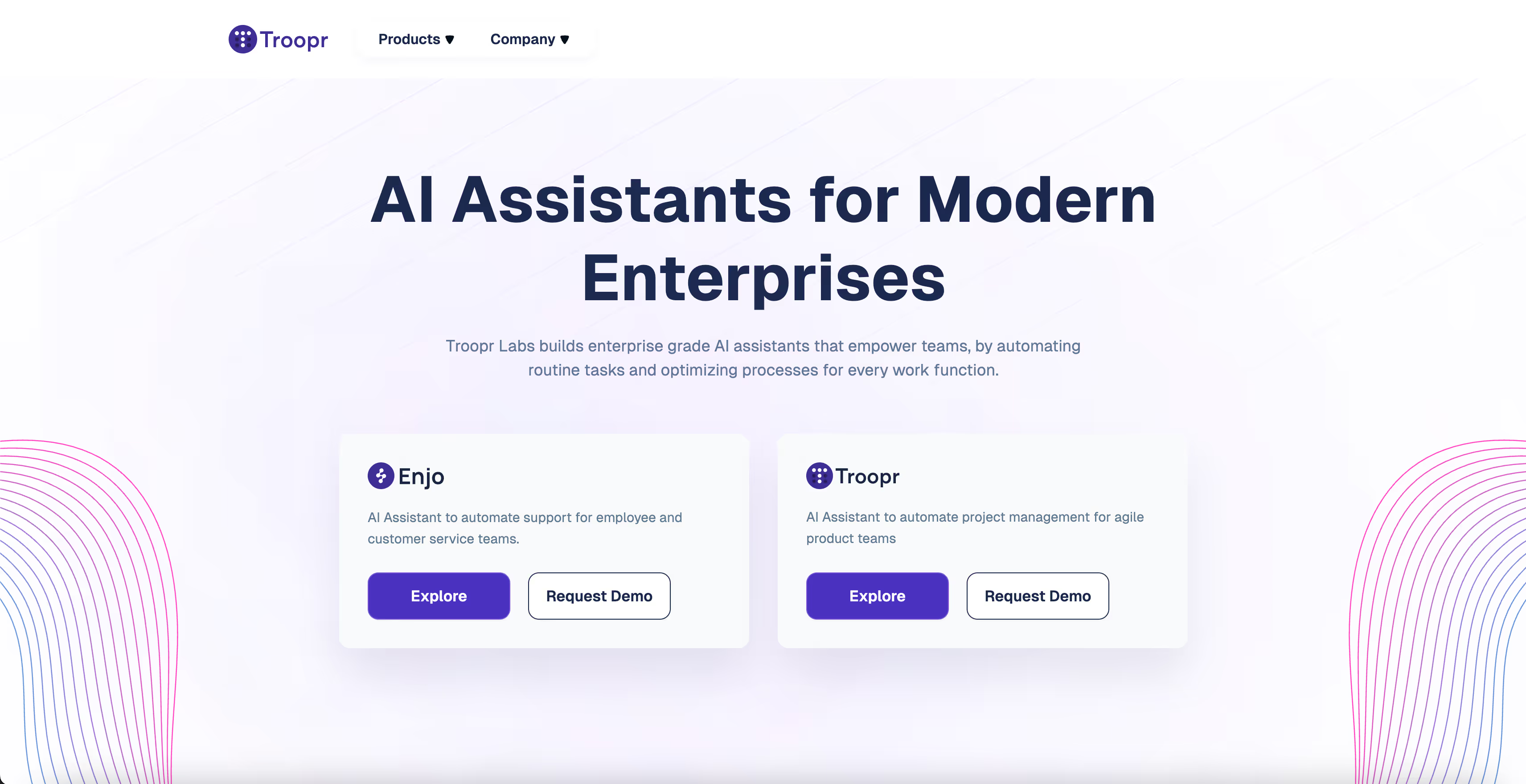
Best for: Sales-to-Engineering Handoffs (Jira Focus)
Pricing: Workspace based ($49 - $299/mo).
Key features:
- Jira-First Integration: Connects Slack deeply to Jira.
- Ticket Creation: Allows Sales to create "Feature Requests" in Jira directly from Slack and map them to Accounts.
Strengths: Dominates the Sales-Product-Engineering flow. Essential for B2B SaaS companies where sales requires deep collaboration with technical teams.
Considerations: Niche focus. While it handles Jira well, it is often used alongside a dedicated sales orchestration tool like Momentum for the core Sales-Legal-Finance workflows.
Comparison Table: 2025 GTM Automation Landscape
::autotable
::columns=6
Feature Category
Momentum.io
Rattle
Slack Sales Elevate
Scratchpad
Troopr
Primary Function
Orchestration & Agents
Process Adherence
Native CRM Interface
Rep Productivity UI
Jira/Eng Collaboration
Slack Integration
Deep / Bi-directional
Deep / Bi-directional
Native / Dashboard
Limited / Sharing
Deep (Jira Focus)
Deal Rooms
Automated Lifecycle
Dynamic Creation
Manual / Basic
N/A
Project Channels
AI Maturity
Agentic (Executes Work)
Generative (Summaries)
Einstein (Generative)
Assistive
Support Agents
Workflow Builder
Advanced (Multi-step)
Low-Code (Linear)
Basic (Slack WF)
N/A
Jira Workflows
Custom Objects
Full R/W Support
Full R/W Support
Supported
Limited
Custom Fields (Jira)
Latency
Real-time (Webhooks)
Real-time (Webhooks)
Delayed (5-10m)
Real-time
Real-time
Pricing Model
Platform Fee
Per User
$60/user/mo
Freemium / Per User
Per Workspace
::endautotable
Not a Replacement, An Advantage
A common misconception is that purchasing an orchestration platform means replacing your existing tech stack. This is false. Momentum is not here to replace Salesforce, Gong, or Clari. It is here to make them usable.
Smart buyers treat Gong and Clari as inputs (Signals) and Momentum as the router (Action). Momentum sits as the connective tissue in your ecosystem, ingesting raw data from your intelligence platforms and turning it into structured CRM data and targeted notifications.
The "System of Action" Advantage
While automation tools like Zapier or simple connectors handle linear tasks (e.g., "add row to Google Sheets"), Momentum handles complex, state-aware business logic.
1. Real-Time Insights & Risk Intervention
Standard dashboards look backward. Momentum looks forward. Its AI agents monitor activity velocity—not just static fields. If a deal in "Negotiation" hasn't had an email exchange in 5 days, the Deal Execution Agent identifies this as a "Stalled Deal" risk. It actively pings the sales rep with a suggested re-engagement email, preventing revenue leakage before it happens.
2. Automated Data Hygiene
Bad data kills forecasting accuracy. Instead of relying on manual tasks and nagging, Momentum’s Enterprise Listening capability ingests call summaries and metrics from Zoom and Gong. If a competitor is mentioned, Momentum updates the "Current Competitor" field in Salesforce automatically. This ensures your CRM reflects reality, not just a rep's memory.
3. Streamlining the "Quote-to-Cash" Cycle
Approvals are the silent killer of deal velocity. Momentum transforms the rigid Salesforce approval process into an interactive Slack conversation. When a rep requests a discount, the VP receives a rich message containing margin analysis and deal context. With one click ("Approve"), Momentum updates the quote status, generates the PDF, and notifies the rep. This reduces approval times from days to minutes.
4. The "Deal Room" Engine
For sales teams managing complex enterprise cycles, collaboration is chaotic. Momentum automates the entire lifecycle of the deal room. When an opportunity advances, it creates the channel, maps the account team, injects a "Deal Brief" into the canvas, and—crucially—archives the entire chat history back to Salesforce upon closing. This preserves the unstructured intelligence that typically vanishes into the ether.
Strategic Recommendations for 2025
Return on Investment (ROI) Models
When building a business case for budget, consider how these tools deliver value:
- The Efficiency ROI (Rattle/Scratchpad): These tools justify cost by saving sales rep time on repetitive tasks. If you save 10 minutes per rep/day, you gain incremental productivity.
- The Orchestration ROI (Momentum): Momentum drives strategic revenue impact. By improving data integrity, you improve forecast accuracy. By automating handoffs and approvals, you shorten the sales cycle. This allows organizations to delay hiring additional RevOps headcount by automating the administrative burden entirely.
Why Momentum Wins the Enterprise
For organizations with complex GTM motions, Momentum is the clear recommendation. Its architectural decision to focus on Agentic AI places it ahead of the curve. While other apps are building better ways for humans to interact with data, Momentum is building ways for software to manage the data for us.
Key Buying Signals for Momentum:
- Complex Deal Cycles: You have SEs, CSMs, and Execs involved in every deal.
- Data Integrity Issues: Your forecast is unreliable because reps don't log data.
- Operational Drag: Your Deal Desk or Legal review process is a bottleneck.
- Tech Stack Maturity: You use Gong, Clari, and Salesforce and need a way to connect them.
When to Choose Alternatives
- Choose Rattle if: You are a mid-market company needing simple compliance alerts up and running in 48 hours via a no-code builder.
- Choose Slack Sales Elevate if: You are a strict "Salesforce Shop" focused on vendor consolidation and basic opportunity management.
- Choose Scratchpad if: Your primary pain point is rep dissatisfaction with the Salesforce UI and you need a fast interface for bulk edits.
The Future: The Autonomous Revenue Engine
As we look toward 2030, the GTM function will become increasingly autonomous. AI agents will handle prospecting, scheduling, and basic renewals. The role of the human seller will shift entirely to relationship building and strategic negotiation. In this future, the Orchestration Layer becomes the most critical piece of software in the stack.
By investing in a platform like Momentum today, you are building the infrastructure for this autonomous future. You aren't just optimizing the workflows of the past; you are engineering the revenue engine of the future19.
Ready to Architect Your Autonomous Revenue Team?
Stop drowning in "dark data" and manual busywork. Join the revenue teams that are closing the Execution Gap with Agentic AI.
Book a demo to see how Momentum integrates with your current stack and automates your highest-impact sales workflows.