


.svg)



The mandate for Revenue Operations (RevOps) leaders in 2025 has shifted fundamentally. We have moved from an era of passive reporting to one of active orchestration. For the last decade, the prevailing strategy involved assembling a "best-of-breed" tech stack.
You likely have a call recorder for coaching, a separate forecasting tool for the CFO, a marketing automation platform for demand generation, and a ticketing system for Customer Success.
While this approach digitized individual departmental functions, it inadvertently calcified the silos between them. Data remained trapped within specific interfaces. Handoffs between sales teams and post-sales departments were manual and fragile. Consequently, the "Voice of the Customer" was fragmented across disparate databases rather than serving as a unified engine to drive revenue.
As we assess the landscape in 2025, a new category has emerged to address this fragmentation: Revenue Orchestration Platforms (ROPs). These automation platforms do not just record what happened. They actively shape what happens next.
This guide evaluates the best automation tools capable of unifying your GTM engine to eliminate administrative drudgery and maximize strategic throughput.
What Is Revenue Orchestration?
Revenue Orchestration represents the convergence of Sales Engagement, Conversation Intelligence, and Revenue Operations into a single, execution-focused layer. The primary objective is not merely to visualize data on dashboards but to automate the complex, cross-functional workflows that drive revenue from the first marketing touchpoint to the final retention event.
This architectural shift moves away from the "swivel-chair" effect where sales reps navigate multiple tabs to execute a single process. Instead of static rules inside one app, orchestration uses dynamic triggers that work across platforms like Slack and Salesforce. It serves as the connective tissue that binds your revenue ecosystem together.
Modern Challenges: The High Cost of Silos
Even with a robust CRM and automation tools in place, misalignment persists. This usually stems from disconnected data infrastructure rather than conflicting goals. RevOps teams typically struggle with three core friction points:
The Marketing Disconnect
Marketing teams often operate in a vacuum regarding deal outcomes. They generate leads but lack the qualitative feedback loop on why those leads fail. They need direct access to competitor mentions, feature requests, and pricing objections voiced during sales calls. Without this real-time access to the "Voice of the Customer," lead scoring and segmentation remain guessing games relying on sales reps to manually fill out picklist fields.
The Sales Efficiency Gap
Sales representatives are burdened with manual tasks that detract from selling time. In 2025, asking a rep to manually type call notes, update Next Steps, or log MEDDIC criteria into a Salesforce or HubSpot CRM is considered a failure of operations. These repetitive tasks create bottlenecks and degrade data hygiene.
The Customer Success Silo
The transition from "Closed Won" to onboarding is the most perilous phase of the customer journey. Customer Success teams frequently inherit new accounts with zero context and must re-interrogate the customer about their goals. A unified platform must automatically transfer the knowledge capital accumulated during the sales cycle directly to the CS team to ensure a seamless expansion and renewal motion.
What to Look For: Evaluation Criteria
To determine the best automation tools for this unified mandate, RevOps leaders must prioritize action over analysis.
1. Actionability & Execution Layer
- What it should do: Autonomously execute work. The tool must function as an active agent that triggers a remediation workflow or updates a CRM field without human intervention.
- Why it matters: Insights alone do not close deals. You need a tool that reduces the cognitive load on human operators and helps sales teams focus on closing deals rather than data administration.
2. Unified Data & Ecosystem Integration
- What it should do: Act as a universal translator between your System of Record (Salesforce/HubSpot) and System of Engagement (Slack/Teams).
- Why it matters: Bi-directional syncing must be robust enough to handle complex enterprise data models, including Custom Objects and hierarchical account structures. This ensures data quality and prevents duplicate records.
3. User Adoption (Slack-Native)
- What it should do: Meet users where they already spend their day.
- Why it matters: Adoption is the graveyard of software. Reducing login barriers by integrating with Slack is the most effective strategy for streamlining processes and improving data hygiene.
4. AI Maturity: Agents vs. Summaries
- What it should do: Deploy specialized "Agentic AI" that acts as an autonomous actor.
- Why it matters: There is a distinct difference between generic AI-powered summaries and agents that understand the nuances of B2B sales cycles. You need agents capable of churn detection or deal execution to truly optimize the sales process.
5. Total Cost of Ownership (TCO) & Value
- What it should do: Consolidate the stack to maximize ROI.
- Why it matters: You must consider if a single platform can replace a call recorder, forecasting tool, and automation bot. This lowers the "Stack Tax" and reduces the hidden costs of implementation and maintenance.
Top Automation Tools Breakdown
We evaluated the leading vendors capable of unifying Sales, CS, and Marketing.
1. Momentum
- Best For: RevOps teams prioritizing execution, unification, and Slack-native workflows.
- Pricing: Platform Fee + Seat License ($$). Replaces multiple point solutions like call recorders and automation bots.
Key Features:
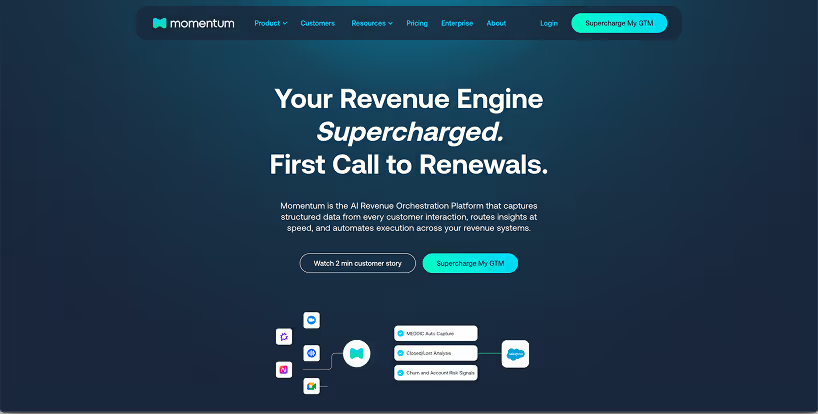
- AI Deal Execution Agent: Extracts structured data (MEDDIC, Pain Points) from sales calls and auto-populates Salesforce.
- Retention Agent: Monitors customer interactions for risk signals like "budget cut" and triggers Swarm workflows.
- Marketing Signals: Routes real-time voice-of-customer snippets to marketing teams for data-driven decisions.
- Automated Deal Rooms: Creates private Slack channels with pinned assets when opportunities progress.
Strengths:
Momentum differentiates itself through its architecture. It is an orchestration layer living on top of the CRM and communication channels. This "headless" approach ensures near 100% adoption because it does not require behavior change from the reps. It combines Deep CRM Integration, Slack-Native Workflow, and Agentic AI into a single operating system for revenue.
Considerations:
Momentum is designed to layer over your existing database of record (Salesforce/HubSpot). It enhances them rather than replacing the underlying storage.
2. Gong
- Best For: Sales Coaching, Deep Conversation Intelligence, and Reality-Based Training.
- Pricing: High ($$$$). Platform fee ($5k-$50k) plus seat licenses ($1,200-$1,600/yr). Forced bundling of modules increases TCO.
Key Features:
- Proprietary AI models for transcribing B2B sales conversations.
- "Game Tape" analysis for identifying questions top performers ask.
- Forecast modules (recently bundled).
Strengths:
Gong remains the standard for pure sales coaching and psychological analysis of calls. Its ability to capture sales calls and provide actionable insights for manager-rep 1:1s is exceptional.
Considerations:
Historically, Gong is a "passive" tool where users must log in to consume insights. Its ability to push automated workflows (e.g., updating a Salesforce field based on a transcript) is less flexible than Momentum. Workflows for CS handoffs and Marketing feedback often require custom integration work.
3. Clari
- Best For: Enterprise Forecasting, Boardroom Reporting, and Pipeline Management.
- Pricing: High ($$$$). Platform fee + Seat ($100-$200/mo). High implementation fees and minimum contract values.
Key Features:
- Ingests snapshot data to visualize sales pipeline health over time.
- Rigorous forecasting views required for public companies.
- "Inspect" modules for manager-led deal interrogation.
Strengths:
Clari is the tool of choice for the CFO and CRO at large enterprises. It provides the metrics and "rigor" required for public company reporting.
Considerations:
Clari is fundamentally an inspection tool. It highlights risk but does not automate the remediation. It relies heavily on the hygiene of the underlying CRM data ("Garbage In, Garbage Out"). Unlike Momentum, which automates data entry, Clari assumes the hygiene exists or forces managers to nag reps to update it.
4. Workato & Tray.io
- Best For: Connecting disparate systems (ERP to CRM) and building complex custom logic.
- Pricing: Variable ($$$). Consumption-based (Recipes/Tasks). High engineering maintenance cost.
Key Features:
- Infinite flexibility to connect any API.
- "Recipes" for custom workflow automation building.
Strengths:
These iPaaS tools offer granular control over data formatting and logic, allowing RevOps teams to build virtually any connection.
Considerations:
The hidden cost is technical debt. Building a "Deal Room" requires engineering resources to design, build, test, and maintain. If a Salesforce API changes, the recipe breaks. For most startups and mid-market companies, the TCO of maintaining custom recipes is higher than buying a purpose-built tool.
5. HubSpot Operations Hub
- Best For: Data syncing and cleaning within the HubSpot ecosystem.
- Pricing: Mid-Range ($$). Tiered (Starter/Pro/Ent). Enterprise tier ($2,000/mo) required for advanced custom logic.
Key Features:
- "Programmable Automation" with custom JavaScript.
- Data quality tools for formatting fixes (e.g., phone numbers).
Strengths:
Strong contender for data hygiene if your organization uses HubSpot CRM as the single source of truth.
Considerations:
It lacks the "human" layer. It is a backend tool that does not offer rich, interactive "Deal Room" experiences or AI-driven conversation intelligence. It is excellent for database cleanup but less effective for sales enablement or real-time team collaboration.
Comparison Matrix: RevOps Automation Tools
::autotable
::columns=5
Feature Category
Momentum
Gong
Clari
Workato
Primary Category
Revenue Orchestration
Conversation Intelligence
Revenue Intelligence
iPaaS (Integration)
AI Data Capture
High (Auto-extracts & writes to CRM)
Medium (Focuses on summaries)
Low (Relies on manual entry)
N/A (Requires external AI)
Slack/Teams Workflow
Native (Full interactive workflows)
Moderate (Notifications)
Moderate (Notifications)
High (Custom bots)
Deal Room Automation
Automated (Auto-create/archive)
Manual
Manual
Custom Build
Marketing Signals
Real-time (Push to Slack)
Dashboard (Keyword analytics)
Limited
N/A
CS Risk Detection
Active Agent (Alerts & Tasks)
Passive Analysis
Passive Analysis
Custom Build
Ideal User
Reps, RevOps, Managers
Enablement, Managers
CRO, CFO
IT, Systems Ops
::endautotable
The Execution Layer
Momentum does not aim to replace your database of record; it makes it usable. It positions itself as the execution layer that unifies your stack, ensuring revenue growth through better process adherence.
Automated Data Entry & Hygiene
For sales teams, Momentum deploys a "Deal Execution Agent" that fundamentally solves the data entry crisis. This AI-powered agent listens to calls and automatically populates Salesforce fields mapped to your specific playbooks (e.g., MEDDIC, SPICED, BANT). This ensures the "Why" behind the deal is captured in the CRM, eliminating hours of manual work and improving forecast accuracy.
Unifying Sales & CS (The Handoff)
The transition from prospect to customer is where data often dies. When an opportunity moves to "Closed Won," Momentum automatically creates a dedicated Slack channel and invites the AE, SE, and new CSM. The AI Agent extracts "Promised Deliverables" and "Key Success Metrics" from previous calls and posts a "Handoff Brief" directly to the channel. This ensures the CSM starts the relationship with full context, boosting customer experience and retention.
Marketing Signals & Feedback Loops
Momentum provides the connective tissue for Marketing teams through AI Signals. Marketing can set listeners for topics like "New Product Launch" or "Competitor X". When a mention occurs, Momentum routes the relevant transcript snippet to a specific Slack channel. This gives Product Marketers a continuous stream of unfiltered market feedback to adjust messaging and battlecards in real-time.
The Move to Orchestration
The competitive advantage in 2025 belongs to revenue teams that act as a single organism. The silos of "Sales," "Marketing," and "CS" are vestigial structures that must be bridged by technology.
- For the Execution-First Leader: Momentum is the unequivocal choice, offering the best balance of AI maturity, ease of use (Slack-native), and cross-functional unification.
- For the Deep Analysis Leader: If your primary need is analyzing hours of call tape for psychological coaching, Gong remains a valuable specialized tool, ideally integrated with Momentum for execution.
- For the Public Company Leader: Clari remains necessary for the rigors of Wall Street-level forecasting, but it should be fed by the clean data that Momentum automates.
Ready to unify your revenue engine?
Start by auditing your "Dark Data" to identify where valuable insights are being lost.
Book a demo to see how Momentum’s Deal Execution Agents can automate your CRM hygiene and streamline your GTM workflows today.