


.svg)



Best AI Call Recording and Analysis Tools for Sales Teams
Sales conversations are goldmines of data, but only if you can extract them and act on them fast.
AI call recording tools have solved the first part: capturing what's said. But most sales teams still struggle with the second part: turning insights into revenue actions.
In this guide, I'll walk you through the leading conversation intelligence platforms, what makes them different, and how to pick the right one for your team. Then I'll show you the missing piece most teams overlook and how Momentum fills that gap.
What AI Call Recording Tools Actually Do
Before comparing specific platforms, let's talk about what you're actually buying.
Modern AI call recording tools do far more than just hit record. They automatically transcribe conversations, analyze sentiment, flag buying signals and objections, detect deal risks, and populate your CRM. They create a searchable library of every customer interaction so you can spot patterns across hundreds of calls.
Here's what the best ones include:
Automatic transcription. Every word is captured and searchable—in English, Spanish, Mandarin, and dozens of other languages.
Sentiment analysis. The tool listens for emotional tone. Is the customer frustrated? Excited? Hesitant? This matters because it predicts deal outcomes.
Keyword spotting. The AI flags mentions of competitors, pricing objections, buying signals, and custom keywords you define. You never miss a critical moment.
Deal risk flagging. The system learns what healthy deals look like and alerts you when a conversation shows warning signs—stalled progress, customer frustration, decision-maker absence.
CRM integration. Call data automatically syncs to Salesforce, HubSpot, or your CRM of choice. Fields populate, notes save, and deal stages update based on what was discussed.
Performance coaching. The tool analyzes rep behavior: talk-to-listen ratios, objection handling, discovery questions asked, closing techniques used. Managers get coaching scorecards without listening to every call.
Searchable call library. You can search across all calls for patterns. "Show me every call where we lost to a competitor" or "Find calls where the customer mentioned budget constraints." This is where real insights emerge.
These capabilities exist across all the major platforms. The differences are in depth, ease of use, and what happens after the insights are surfaced. That's where things get interesting.
The Business Case for Call Analysis
Let me give you the numbers that matter.
Sales teams spend roughly 40% of their time on administrative tasks: taking notes, updating CRM fields, writing follow-ups, scheduling next steps. Call recording tools can cut that time significantly by automating what used to require manual work.
But the bigger impact is on selling itself.
Research shows that reps who listen more than talk—maintaining roughly a 40:60 listening-to-talking ratio—close 30% more deals than reps who dominate conversations. Call analysis tools make this visible. Managers can see which reps ask discovery questions, which ones pitch too early, which ones handle objections effectively. Then they can coach to it.
Companies using conversation intelligence see win rate improvements of 15-25% within the first year. That's not theoretical—it's what the data shows across thousands of teams.
Real-time coaching accelerates this further. Reps who get immediate feedback on their calls improve 20%+ faster than those who wait for monthly coaching sessions.
For a 20-person sales team, this translates to:
- 400+ hours saved per year on administrative work (that's 10 weeks of productive selling time)
- 3-5 additional deals closed per rep per year (from improved technique)
- Faster onboarding for new reps (they learn from recorded calls instead of shadowing)
- Better forecasting accuracy (you see deal health in real conversations, not just pipeline stage)
For most teams, that's millions of dollars in incremental revenue. But here's the catch: you only get that value if insights actually drive action. And that's where most call recording tools fall short. They tell you what happened. They don't tell you what to do about it.
Gong: The Enterprise Revenue Intelligence Leader
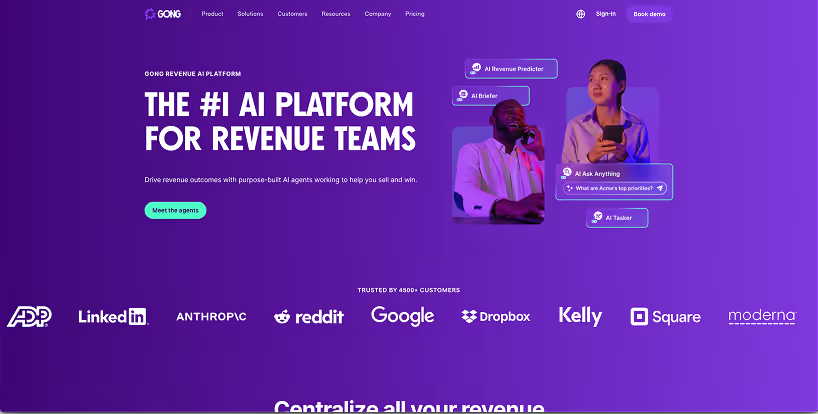
Gong is the market leader in conversation intelligence. If you've heard of call recording tools, you've probably heard of Gong.
Why they're the leader: Gong has been in this space longer than anyone and has built the deepest analytics engine. They've recorded millions of calls across thousands of companies. That data is their moat.
Who it's for: Enterprise sales teams with 50+ reps and budgets to match. Gong is built for scale.
Pricing: $1,600-$1,360 per user per year, with custom enterprise quotes that go higher. For a 20-person team, expect $30k-40k annually. For 100 reps, you're looking at $150k+.
Key features:
- Deal intelligence. Gong predicts deal outcomes based on conversation patterns. It flags deals that look like they'll slip, close, or turn into churn. This is surprisingly accurate.
- Market insights. Gong aggregates themes across all your calls. What are customers saying about your pricing? Your competitors? New product requests? You get a real-time market view.
- Talk patterns. Gong tracks which sales techniques your top performers use. Discovery questions. Objection handling. Closing language. It quantifies what works.
- Moment-driven insights. Instead of watching entire calls, Gong surfaces the moments that matter—the objection, the buying signal, the decision-maker's hesitation.
- Integrations. Salesforce, HubSpot, Slack, Outreach, Salesloft. It connects to your entire stack.
Strengths:
- Deepest analytics on market and customer trends. If you want to understand your market, Gong is unmatched.
- Enterprise-grade security and compliance. Works at Fortune 500 scale.
- Proven at scale. Thousands of companies, millions of calls. The data is battle-tested.
- Powerful custom insights. You can ask almost any question about your calls and get an answer.
Limitations:
- High cost. If you're a 10-person startup, Gong is expensive.
- Steep learning curve. The platform is feature-rich, which means it takes time to get value. New users often feel overwhelmed.
- Feature bloat. Not every sales team needs market-level insights. Sometimes you just need to know if your rep asked discovery questions.
- Execution gap. Gong tells you what happened. It doesn't automate what comes next.
Momentum AI angle: Gong excels at providing visibility into what's happening in calls. You see patterns, risks, and opportunities. But then what? Momentum AI takes those insights and automates the next steps—updating deal stages, triggering follow-ups, routing coaching to managers, and alerting leadership to at-risk accounts. Gong answers "What happened?" Momentum answers "What do we do about it?"
Claap: The Collaborative Alternative
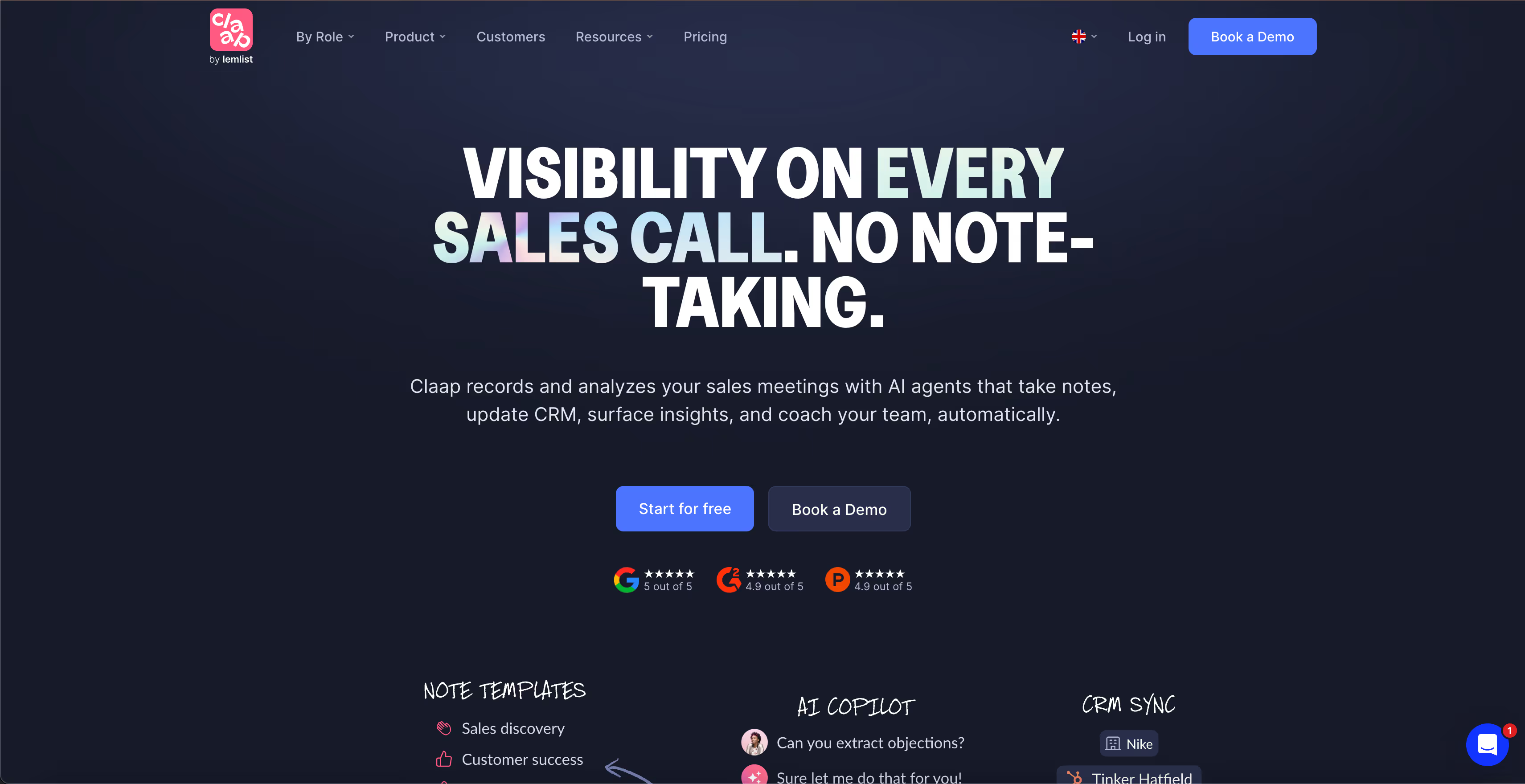
Claap is the rising challenger in this space. They're newer than Gong but they're building something different—and faster.
Why they stand out: Claap treats call data like a collaborative workspace. Think Notion for sales conversations. They've optimized for speed of implementation and ease of use, not just feature count.
Who it's for: Mid-market teams (15-50 reps) that want fast onboarding and lower total cost of ownership. Teams that value collaboration across sales, customer success, and product.
Pricing: Significantly lower than Gong. Expect $400-800 per user per year. A 20-person team runs $8k-16k annually. That's 3-5x cheaper than Gong for comparable features.
Key features:
- Collaborative workspace. Call data isn't locked in dashboards. It's organized in a workspace where reps, managers, and cross-functional teams can access and discuss insights together.
- AI agents. This is Claap's differentiator. AI agents automatically handle tasks: populate CRM fields, surface churn risk, write follow-up emails, create meeting summaries. You get automation without complex workflows.
- Deal pipeline insights. See deal health across your pipeline. Which deals are stalling? Which ones are accelerating? Which reps need help?
- Flexible data organization. Organize calls by customer, deal, rep, or custom criteria. Find what you need fast.
- Native integrations. Salesforce, HubSpot, Slack. Claap connects to your tools without friction.
Strengths:
- Fastest onboarding in the category. Live in under 5 minutes. No 6-week implementation.
- Better UX than enterprise alternatives. Claap's interface is modern and intuitive. Your reps will actually use it.
- Lower total cost of ownership. You get 80% of Gong's features at 20% of the cost.
- Cross-functional collaboration. Customer success, product, and marketing can all access call insights. This drives company-wide learning.
Limitations:
- Smaller customer base. Claap hasn't been around as long. Less battle-tested at massive scale.
- Fewer advanced analytics. Gong's market insights are deeper. Claap is stronger on team-level insights.
- Limited international presence. If you have global teams, Gong has better infrastructure.
Momentum AI angle: Claap's strength is making call data accessible and actionable across your team. Momentum extends this by automating the execution. While your team is discussing insights in Claap, Momentum is already updating your CRM, routing coaching, and triggering workflows. Together, they're powerful.
HubSpot Conversation Intelligence: The Native CRM Option
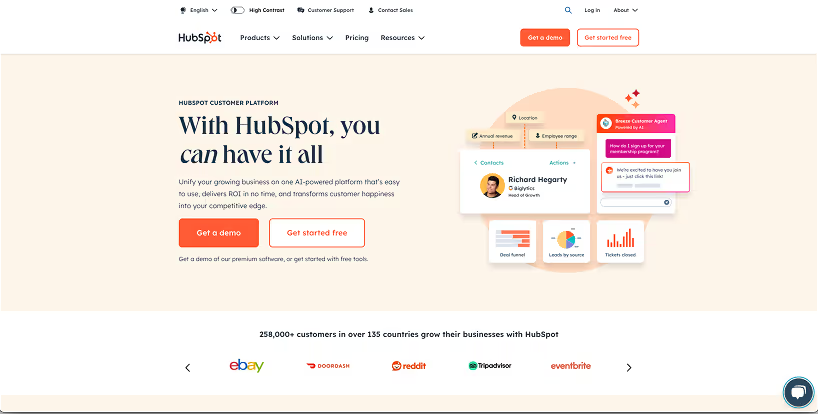
If you're already in HubSpot, this is the path of least resistance.
Why it matters: HubSpot integrated call recording directly into their CRM. No switching between tools. No data silos. Everything lives in one place.
Who it's for: HubSpot Sales Hub users who want to keep their tech stack simple. Smaller teams (under 30 reps) that don't need advanced analytics.
Pricing: Included in HubSpot Sales Hub Enterprise ($1,200/month for 5 users, then $120 per additional user). So for a 20-person team, you're looking at roughly $2,400-3,000 per month. That's expensive if you're just buying HubSpot for this feature, but it's cheap if you're already a customer.
Key features:
- Native call recording. Works with Zoom and HubSpot's calling tool. Hit record and the conversation is captured.
- Automatic transcription. Powered by OpenAI. Transcripts appear in the contact record automatically.
- Keyword search. Find calls where specific words were mentioned. Search across all your calls.
- Coaching tools. Managers can leave timestamped feedback on call transcripts. Reps get coaching without waiting for a meeting.
- Auto-summaries. HubSpot's AI generates call summaries that populate the CRM automatically.
- Zero integration friction. Everything lives in HubSpot. No APIs to configure.
Strengths:
- No tool switching. Your reps already live in HubSpot. Call recording is just another feature.
- Easy setup. If you have HubSpot, you can enable this in minutes.
- Affordable if you're already a customer. The per-unit cost is low.
- Good enough for most teams. You don't need advanced analytics if you're under 50 reps.
Limitations:
- Limited analytics depth. HubSpot CI doesn't have Gong's market insights or deal prediction engine.
- Basic coaching. The coaching tools are simpler than Chorus or Gong.
- Less sophisticated AI. HubSpot's AI is good, but it's not as specialized as platforms built solely for call analysis.
- Limited to HubSpot ecosystem. If you use Salesforce, this doesn't work.
Momentum AI angle: HubSpot CI keeps calls in your CRM, which is smart. But Momentum goes further. It doesn't just record calls—it orchestrates your entire revenue process around what's actually happening in those calls. While HubSpot CI stores call data, Momentum automates deal execution, coaching, and forecasting based on that data.
Chorus by ZoomInfo: Enterprise Coaching Focus
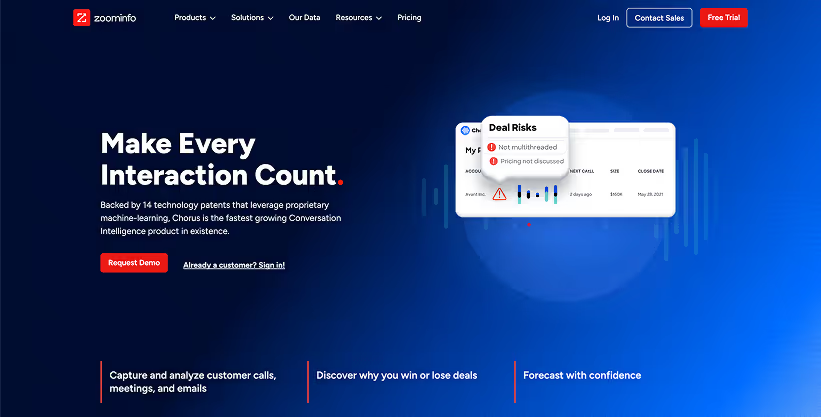
Chorus is part of the ZoomInfo ecosystem, and it's built with a specific focus: coaching at scale.
Why it exists: ZoomInfo owns the B2B data layer. Chorus integrates call data with that intelligence. You get conversation insights plus account intelligence.
Who it's for: Enterprise teams (50+ reps) that prioritize coaching and competitive intelligence.
Pricing: Quote-based, often bundled with ZoomInfo. Expect $1,000+ per user per year for enterprise customers. Pricing varies widely based on bundling.
Key features:
- Moment-driven insights. Chorus surfaces the moments that matter: objections, buying signals, competitor mentions, decision-maker engagement.
- Personalized coaching. Managers can leave feedback directly on call transcripts. Reps get specific, actionable coaching tied to real moments.
- Competitor mention tracking. Every time a competitor is mentioned, Chorus flags it. You get real-time competitive intelligence.
- Account intelligence. Integrated with ZoomInfo's B2B database. You see call insights plus company data, decision-maker info, and org charts.
- Slack integration. Key moments surface in Slack automatically. Coaching and alerts reach reps in real-time.
Strengths:
- Excellent coaching workflows. If coaching is your priority, Chorus is built for it.
- Competitive intelligence. You see competitor mentions across all calls, which is valuable for product and sales strategy.
- ZoomInfo integration. If you're already using ZoomInfo for prospecting, Chorus connects seamlessly.
- Real-time alerts. Critical moments surface immediately, not in a dashboard you check later.
Limitations:
- Pricing often bundled. It's hard to evaluate the standalone cost-benefit.
- Smaller standalone user base. Chorus is strong but less widely adopted than Gong.
- Less market insights than Gong. Gong's aggregated insights are deeper.
- Implementation complexity. Setting up Chorus often requires ZoomInfo integration, which adds complexity.
Momentum AI angle: Chorus surfaces coaching opportunities beautifully. But Momentum automates the coaching workflow. While a manager is reviewing a call in Chorus, Momentum is already assigning the rep to training, triggering real-time nudges during their next call, and measuring coaching impact on deal outcomes. Chorus is reactive coaching. Momentum is proactive, automated coaching.
Comparing the Key Features
Here's how these platforms stack up:
::autotable
::columns=6
Feature
Gong
Claap
HubSpot CI
Chorus
Momentum
Transcription
Yes
Yes
Yes
Yes
Integrates with CI tools
Sentiment Analysis
Yes
Yes
Yes
Yes
Receives from CI tools
Deal Risk Flagging
Advanced
Yes
Limited
Yes
Automates actions
Real-time Coaching
Limited
Limited
Limited
Yes
Automates coaching workflows
CRM Auto-fill
Limited
Yes
Yes
Limited
Full automation (MEDDIC)
Workflow Automation
Limited
Yes
Limited
Limited
Core feature
Slack/Teams Integration
Yes
Yes
Limited
Yes
Native integration
Market Insights
Advanced
Good
Limited
Good
N/A (focuses on execution)
Pricing
High
Medium
Medium
High
Depends on integration
::endautotable
What this tells you: Each tool excels at capturing and analyzing calls. They vary in how they route insights and automate actions. Gong is the analytics leader. Claap is the speed leader. HubSpot CI is the simplicity leader. Chorus is the coaching leader.
But they all leave a gap: the execution gap. Insights sit in dashboards. Reps still manually update CRM fields. Coaching opportunities get missed. Deal risks don't trigger alerts. That's where the real value is left on the table.
The Missing Piece: From Insights to Action
Here's the problem with most call recording tools.
They're designed to answer one question: "What happened in this call?"
That's valuable. You need visibility into your conversations. But it's only half the battle.
The real question is: "What do we do about it?"
Let me paint a realistic scenario. Your rep just finished a call with a prospect. The conversation was good, they asked discovery questions, addressed objections, and the prospect said they'd "love to move forward." The rep thinks it's a win.
But here's what actually happened (based on call analysis):
- The prospect mentioned budget constraints 3 times
- The prospect asked about your competitors twice
- The rep talked 65% of the time (should be 40%)
- The decision-maker wasn't on the call
- No next step was scheduled
A good call recording tool flags these issues. You see them in a dashboard. The insights are there.
But then what?
Does the rep know they talked too much? Probably not, they think the call went great. Does the manager know to coach them? Only if they manually review the call. Does the deal get flagged as at-risk? Only if someone manually checks the risk scoring. Does a follow-up task get created? Only if the rep remembers to add it to their to-do list.
This is the execution gap. Insights exist, but they don't drive action.
Momentum solves this.
Momentum's Deal Execution Agent watches every call and automatically:
- Updates MEDDIC fields in Salesforce based on what was discussed (budget, decision-maker, timeline, etc.)
- Saves call summaries as notes (no more manual note-taking)
- Generates follow-up tasks and email suggestions
- Advances deals when exit criteria are met
- Alerts managers when deals show risk signals
Momentum's Coaching Agent surfaces:
- Rep performance metrics (talk-to-listen ratio, objection handling, discovery questions)
- Coaching scorecards compared to top performers
- Specific skill gaps that need training
- Real-time nudges during the next call (before the rep makes the same mistake again)
Momentum's AI CRO Agent provides:
- Account-level insights (deal health, customer sentiment, risk scoring)
- Rep performance analysis (who's improving, who's struggling)
- Pipeline forecasting (based on what's actually being discussed, not just pipeline stage)
- Churn risk alerts (before customers are at risk)
And Momentum's Customer Retention Agent detects:
- Churn signals in customer calls (dissatisfaction, feature requests going unaddressed)
- Product feedback and feature requests
- Sentiment changes over time
- At-risk accounts that need intervention
The difference: Call recording tells you what happened. Momentum tells you what to do about it and does it automatically.
This is why companies using Momentum see such dramatic improvements:
- Reps spend 50% less time on administrative work
- Deals close 20-30% faster
- Coaching effectiveness improves 40%+
- Churn decreases because at-risk customers are identified early
You get all the visibility of a call recording tool, plus the automation that actually drives revenue.
How to Choose the Right Tool for Your Team
Here's my decision framework.
Choose Gong if:
- You're enterprise-scale (50+ reps) and have the budget
- Deep market and competitive insights matter most to your business
- You want best-in-class analytics and can handle a learning curve
- Your team is willing to invest in getting the most out of the platform
Gong is the most powerful call analysis tool. If you have the resources to use it well, it pays for itself.
Choose Claap if:
- You want to move fast (you need to be live in days, not weeks)
- Total cost of ownership is important
- You're mid-market (15-50 reps)
- You need cross-functional collaboration (sales, CS, product)
Claap is the fastest to value and easiest to use. You won't get Gong's market insights, but you'll get 80% of the features at 20% of the cost.
Choose HubSpot CI if:
- You're already in HubSpot and want to keep your stack simple
- You're under 30 reps and don't need advanced analytics
- Budget is tight and you want to avoid another tool
- You want zero integration friction
HubSpot CI is good enough for most teams. If you're not doing complex sales analysis, it's a smart choice.
Choose Chorus if:
- You need coaching at scale and want it to be a core part of your process
- You use ZoomInfo and want integrated B2B intelligence
- Competitive intelligence is critical to your strategy
- You're enterprise-focused
Chorus is built for coaching. If that's your priority, it's the right choice.
Then layer in Momentum if:
- You want to automate deal execution (not just analyze calls)
- You need your CRM to stay in sync with what's actually happening
- You want real-time alerts on deal risks and churn signals
- You want to reduce admin burden and accelerate deal cycles
- You want to measure revenue impact, not just adoption metrics
Momentum doesn't have to replace call recording tools. It complements them. You use Gong (or Claap, HubSpot CI, Chorus) for visibility. You use Momentum for execution.
Together, they're a revenue machine.
Implementation Best Practices
If you decide to implement a call recording tool, here's how to actually get value from it.
1. Define your use case first.
Are you implementing this for coaching? Deal acceleration? CRM hygiene? Cost savings? Different tools excel at different things. Know what you're optimizing for before you buy.
If coaching is your priority, Chorus and Gong are stronger. If deal acceleration is your priority, Momentum is built for it. If simplicity matters, HubSpot CI. If cost matters, Claap.
2. Set up integrations properly.
Don't just record calls. Connect your call recording tool to your CRM, Slack, and any other tools your team uses. Call data is worthless if it lives in isolation.
Make sure fields map correctly. If your CRM has a "Budget" field, make sure the call recording tool populates it from conversation data. If you have custom fields, set those up too.
3. Create coaching workflows.
Identify the top 3-5 skills you want to improve across your team. Poor discovery questions? Objection handling? Talk-to-listen ratio?
Use your call recording tool to identify reps who struggle with these skills. Create targeted training. Assign specific call clips as examples. Track improvement over time.
4. Automate where possible.
Use AI to populate CRM fields instead of having reps do it manually. Auto-generate follow-up tasks instead of relying on reps to remember. Trigger alerts for deal risks instead of waiting for managers to find them.
This is where Momentum shines. It automates all of this. But even with other tools, you can set up workflows and integrations to reduce manual work.
5. Measure impact.
Track what matters: rep adoption rates, win rate improvements, time saved on admin, and revenue impact. Don't just measure "calls analyzed." Measure actual business outcomes.
Most call recording tools show adoption metrics. Momentum shows revenue metrics. Both matter, but revenue is what actually counts.
The Bottom Line
Call recording tools are table stakes in 2026. If you're not recording and analyzing calls, you're leaving money on the table.
But here's the thing: recording calls is easy. Turning insights into revenue is hard.
The best teams use call recording tools as inputs to a larger revenue orchestration system. They use call data to automate CRM updates, trigger coaching, flag risks, and accelerate deals.
That's what separates winners from the rest.
If you're looking for a call recording tool, pick the one that fits your team's needs and budget. Gong for analytics, Claap for speed, HubSpot CI for simplicity, Chorus for coaching. They're all good.
But if you want to actually turn those insights into revenue, that's where Momentum comes in.
Momentum takes the insights from your call recording tool and automates the execution. Every call moves a deal forward. Every insight triggers an action. Every rep gets coached in real-time.
That's the difference between recording calls and winning deals.
Ready to automate your revenue workflow?
Book a demo today and see how call insights drive deal execution, coaching, and revenue growth.