


.svg)



The Revenue Landscape Has Changed: From Insight to Action
The enterprise revenue landscape has reached a critical inflection point in 2025. For the better part of a decade, sales technology focused on digitization, moving contact cards from Rolodexes to CRM systems and forecasting from spreadsheets to cloud dashboards.
This era created a massive influx of data but birthed a new crisis: the "Insight-Action Gap." Revenue leaders today are drowning in customer interactions (recorded calls, email threads, intent data, and pipeline changes) yet they lack the operational capacity to act on these signals in real-time.
The result is a paradox where organizations possess more intelligence than ever before, yet conversion rates and forecasting accuracy remain stagnant. The market has shifted from "Passive Intelligence", systems that record and visualize data for human review, to "Agentic Orchestration." This new standard demands autonomous systems capable of detecting risks and executing complex workflows without human intervention.
The question is no longer "Did we predict we would miss the quarter?" but "Did the system intervene to help us hit the quarter?"
This guide serves as a strategic roadmap for Chief Revenue Officers (CROs), CIOs, and RevOps leaders. We evaluate solutions not just on feature parity, but on their ability to drive user adoption, enforce sales methodology, and deliver measurable ROI in an economic environment that prioritizes efficiency. We will explore how AI-powered tools are automating the sales process, identifying pain points, and closing the gap between data generation and revenue execution.
What Is Revenue Orchestration?
Revenue Orchestration represents the third phase of sales technology evolution. While Phase I focused on digitization (Salesforce) and Phase II on prediction (Clari, Gong), Phase III is defined by autonomy. An orchestration platform does not just report on the past or predict the future; it actively influences the outcome through workflow automation.
These systems use Agentic AI to act as digital teammates. They can autonomously monitor pipeline health, identify a stalled deal, draft a re-engagement email, update CRM data fields (like MEDDPICC), and notify the VP of Sales via Slack, all without manual intervention. The metric of success has shifted from simple visibility to "Revenue Orchestration," where the system ensures that the right sales reps take the right actions at the right time.
Modern Challenges: Why Traditional Tools Are Failing
Despite the proliferation of tech stack options, revenue teams face three critical failures that modern AI solutions must address.
1. The "CRM Rot" and Manual Entry Burden
In a typical enterprise, a sales representative spends only a fraction of their week actually selling. The remainder is consumed by administrative tasks, primarily manual data entry. Because this process is tedious, it is often incomplete or inaccurate, leading to "CRM Rot." Consequently, forecasting models built on this rotting data become unreliable. If organizations ask reps to log every detail manually, they have already lost the battle for data hygiene.
2. The "Shelfware" and Adoption Crisis
A recurring theme in 2025 is the issue of low adoption for destination platforms. Tools that require reps to log into a separate web portal often become "shelfware"—software that is paid for but rarely used. Users explicitly state preferences for tools that "meet them where they are," which is predominantly Slack and Microsoft Teams. If a tool forces sales teams to switch tabs constantly, it creates friction and lowers usage.
3. The Latency of Decision Making
In the Phase II era, insights were often reviewed retroactively during a weekly pipeline review. In today's high-velocity market, this latency is fatal. A competitive mention or a churn signal needs to be addressed in minutes, not days. Deals are lost because the "save" play was run too late. Modern systems must act as a nervous system, instantly transmitting critical signals to relevant stakeholders to trigger an immediate swarm response.
What to Look For: Evaluation Criteria for 2025
To select the right platform, buyers must evaluate vendors based on their ability to solve these specific challenges. Here are the key criteria to prioritize.
1. Zero-Entry Data Capture
What it should do: The best solutions utilize "Passive Capture" technology. They must automatically ingest emails, calendar events, and call transcripts, using Generative AI to extract key fields (Next Steps, Competitors, Decision Makers) and populate the CRM without the rep lifting a finger.
Why it matters: This solves the "CRM Rot" problem at the source. Accurate historical data is the foundation of reliable predictive analytics.
What to avoid: Tools that rely on manual "logging" plugins or require reps to click "update" after every call.
2. Slack-Native Workflows
What it should do: Effective platforms must be "workflow-native." They should surface actionable insights and enable actions directly within the communication platforms reps use daily. This includes creating "Deal Rooms" in Slack where all signals and approvals are centralized.
Why it matters: This ensures high adoption rates (often exceeding 90%) because the tool aids the rep's daily flow rather than interrupting it.
What to avoid: Destination platforms that force users to log in to a separate dashboard to view insights.
3. Agentic Autonomy and "Reasoning"
What it should do: Look for Agentic AI capabilities. An "Agent" can perceive the environment, reason about a condition (e.g., "Is this deal at risk?"), and execute a workflow (e.g., "Alert manager").
Why it matters: This moves beyond simple summaries to actual problem-solving. It allows the system to intervene in sales cycles proactively.
What to avoid: Legacy Predictive AI that only forecasts trends without offering mechanisms to change the outcome.
4. Real-Time Signal Detection
What it should do: The system must detect critical signals—such as pricing objections or competitor mentions—during the interaction or immediately after, and notify the right people instantly.
Why it matters: Reduces the latency of decision-making. A churn signal detected in an email can trigger a customer success workflow immediately, saving the account.
What to avoid: Systems that only provide insights during weekly reporting cycles.
5. Contextual Data Integration
What it should do: The platform should act as an "All-In-One" listening engine, ingesting data from Zoom, Google Meet, Teams, and Dialpad simultaneously. Advanced integration with data lakes like Snowflake is also a differentiator for customer experience analysis.
Why it matters: Data silos prevent a holistic view of the customer. You need to combine conversation data with product usage data for true visibility.
What to avoid: Closed ecosystems that do not sync readily with your broader data infrastructure.
6. Pricing and Value (TCO)
What it should do: In the era of the "Great Rebundling," buyers are skeptical of expensive per-seat models. Look for flexible pricing or platforms that consolidate multiple tools (recording, alerting, forecasting) into one.
Why it matters: Reducing the Total Cost of Ownership (TCO) is essential. Paying for "add-ons" can double the license cost.
What to avoid: Complex tiered structures where essential features like "Forecast" or "Coaching" are gated behind expensive upgrades.
Top Tools Breakdown: The 2025 Market Landscape
The market is currently bifurcated between established incumbents and a new wave of AI-native disruptors. Here is how the top players stack up.
1. Momentum AI
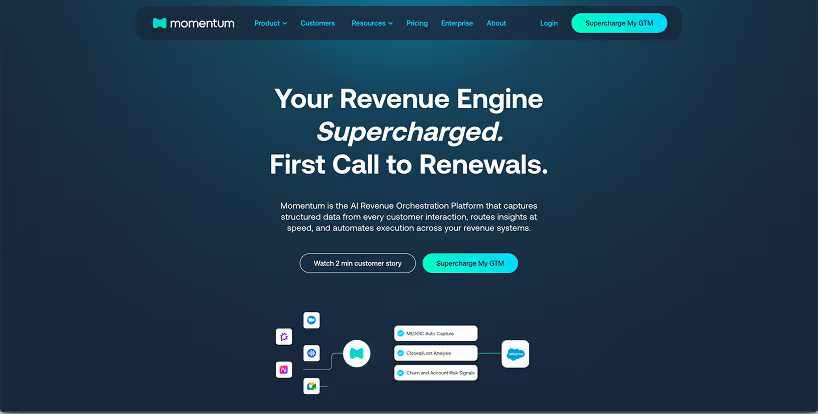
Best for: Revenue Orchestration & Agentic AI
Pricing: Custom pricing (typically undercuts legacy stack by 40-50%)
Key Features:
- Zero-Entry Data Hygiene: Uses LLMs to extract structured data (MEDDPICC) and update Salesforce automatically.
- Slack-Native Deal Rooms: Centralizes signals, alerts, and approvals in Slack.
- Agentic Workflows: Features "Customer Retention Agent" and "Coaching Agent" for autonomous monitoring.
- Zero-Retention Policy: Ensures data privacy for OpenAI usage.
Strengths:
Momentum is the leader in "Actionable AI." It solves the adoption crisis by living entirely in Slack. Its ability to automate the "ground game"—updating fields, triggering Deal Desk approvals, and flagging risks in real-time—makes it indispensable for sales teams focused on execution. It delivers immediate productivity gains by saving reps hours of data entry per week.
Considerations:
While it excels at operational execution, it often works best alongside a BI tool or native CRM reporting for long-term historical trend analysis rather than replacing deep visualization tools entirely.
2. Gong
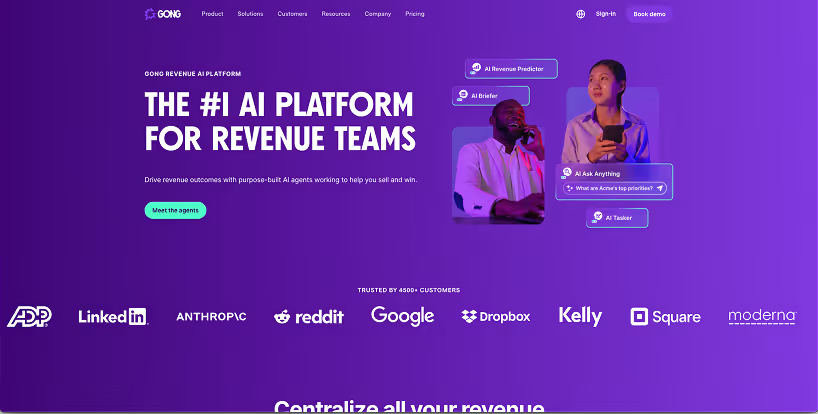
Best for: Enterprise Conversation Intelligence & Coaching
Pricing: High ($1,200 - $1,600/user/year + platform fees)
Key Features:
- Reality Platform: Best-in-class recording and transcription.
- Deal Inspection: Deep analytics on rep behaviors (talk-to-listen ratios).
- Gong Engage: Sales engagement add-on.
Strengths:
Gong defined the category and remains the "safe" choice for sales leaders who prioritize deep analytics and coaching. Its ecosystem is vast, and its "Deal Inspection" capabilities are the industry benchmark for understanding what happened on a call.
Considerations:
It is a "destination" platform, leading to potential "shelfware" issues if reps don't log in. It is fundamentally passive—telling you what happened rather than fixing it automatically. The pricing model is also becoming a friction point for cost-conscious buyers.
3. Clari
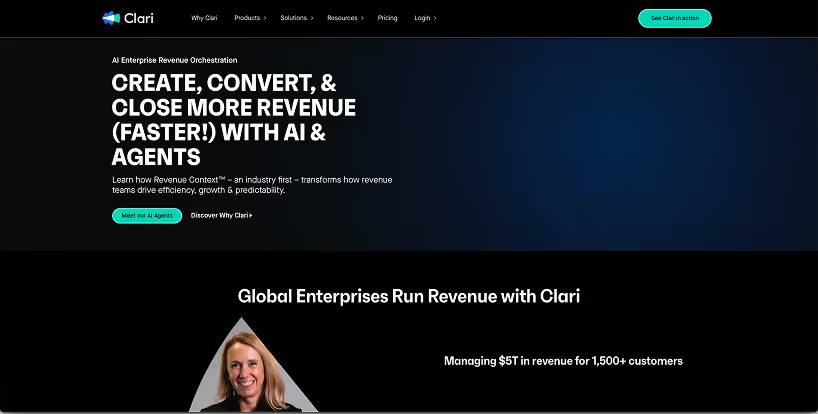
Best for: Revenue Operations & Forecasting Rigor
Pricing: Premium ($2,000+ per user/year for full suite)
Key Features:
- Time-Series Database: Visualizes how pipeline changes over time.
- Forecast Roll-ups: Unmatched rigor for public company prediction.
- Groove Integration: Recently acquired for sales engagement.
Strengths:
For public companies where forecasting accuracy is paramount, Clari is the standard. Its ability to predict "slip" and "flow" is unmatched. It provides board-ready visualizations that give the C-Suite confidence in their number.
Considerations:
Implementation is heavy, often taking 3-6 months. Like Gong, it focuses more on reporting than on the daily orchestration of rep behaviors in Slack. It is expensive and complex to deploy for smaller teams.
4. Oliv
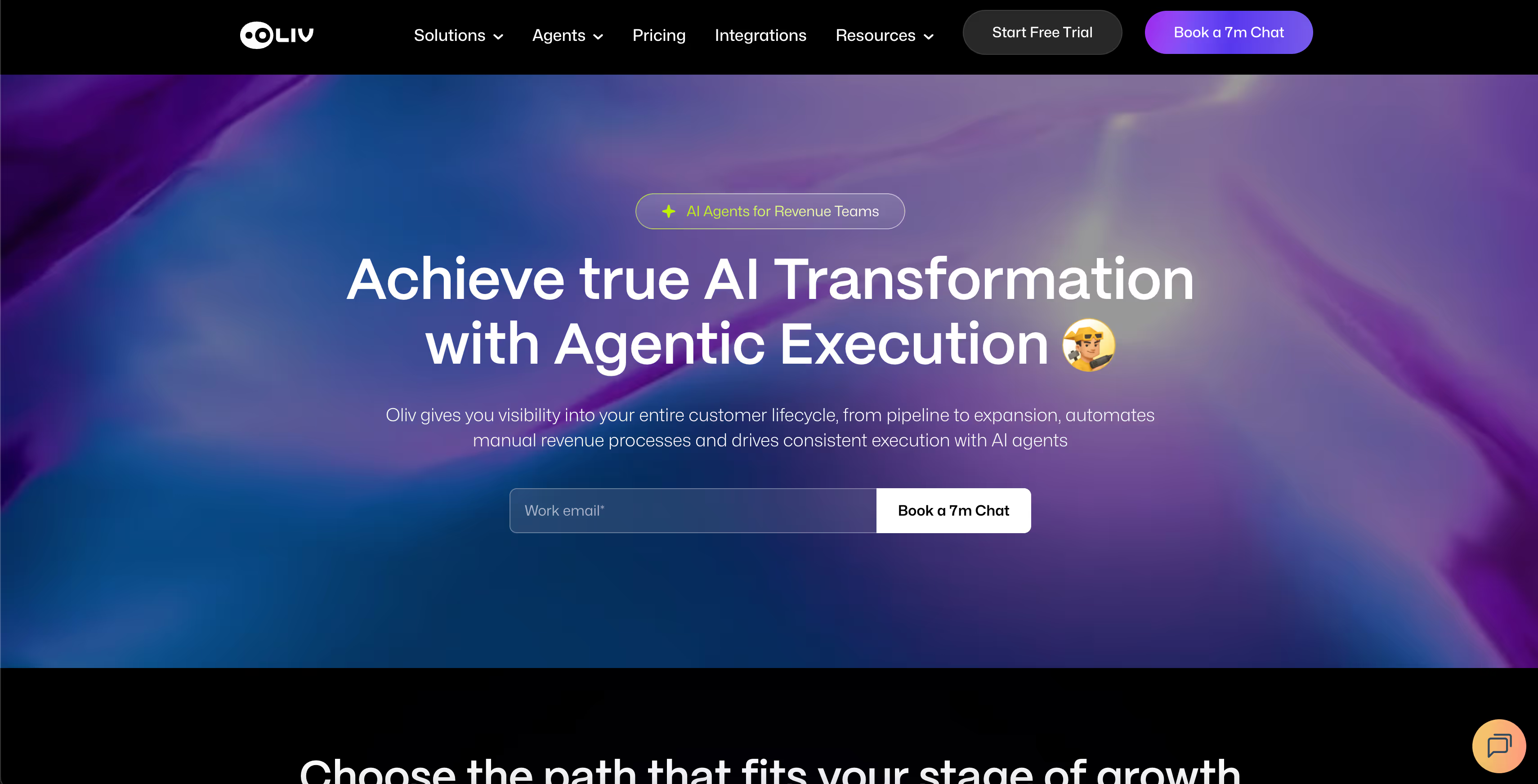
Best for: Cost Consolidation & Efficiency
Pricing: Aggressive (~$19/user/month)
Key Features:
- Consolidated Platform: Recording, summarizing, and basic forecasting.
- Quick Deploy: Up and running in 1-2 weeks.
- AI-Native: Built on Generative AI for lower cost structure.
Strengths:
Oliv positions itself as a direct replacement for the fragmented stack at a fraction of the cost. It is ideal for mid-market companies or those under extreme budget pressure who need "good enough" intelligence without the enterprise price tag.
Considerations:
It lacks the depth of enterprise-grade features found in Gong or Momentum (e.g., complex territory management). Some users note potential reliability issues with transcription compared to established players.
5. Salesforce (Agentforce)
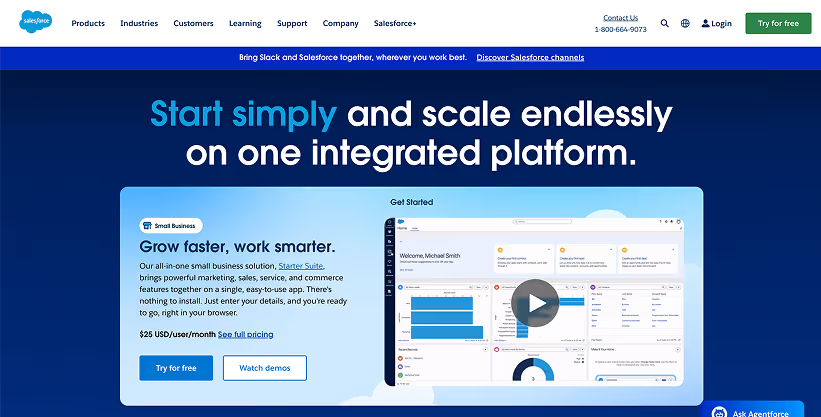
Best for: Platform Extensibility & Customization
Pricing: Expensive add-ons (Einstein layers can be $500/user/mo)
Key Features:
- Agentforce: Allows building custom AI agents inside CRM.
- Native Data: No syncing required; data stays in Salesforce.
Strengths:
"The Platform is the AI." For organizations deeply committed to the Salesforce ecosystem, Agentforce offers infinite customizability. It eliminates data residency concerns.
Considerations:
Usability remains a friction point. Building effective agents requires technical resources. It is often more of a "toolkit" than a productized solution, requiring significant effort to get value.
6. HubSpot (Breeze)
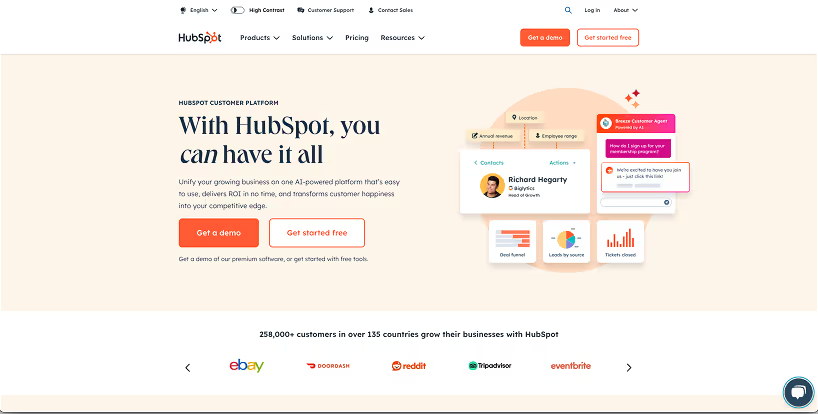
Best for: SMB/Mid-Market Ease of Use
Pricing: Included in higher-tier Sales Hub plans
Key Features:
- Prospecting Agent: Automates research and outreach.
- Breeze Intelligence: Native enrichment and intent data.
Strengths:
Incredible ease of use. HubSpot’s "Prospecting Agent" provides excellent value for smaller teams by automating research without integration headaches.
Considerations:
Lacks the granular pipeline management and forecasting capabilities required by complex enterprise sales organizations. It operates more as an efficiency layer than a deep orchestration engine.
7. Aviso
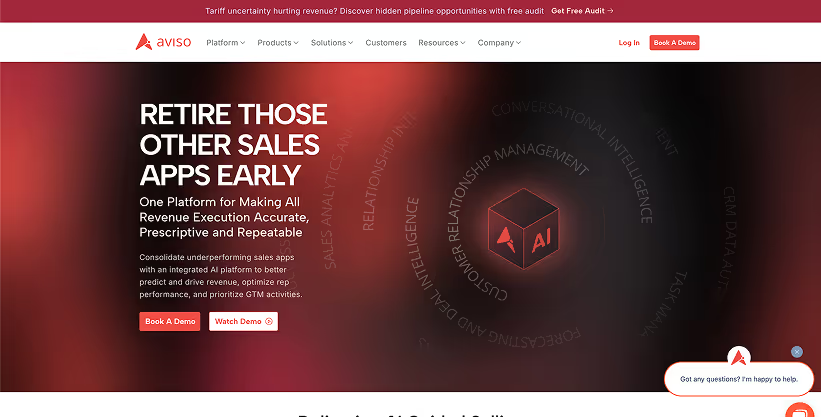
Best for: AI-First Forecasting
Pricing: Competitive enterprise tier
Key Features:
- WinScore: Predictive metric for deal success.
- Single Pane of Glass: Unified forecasting and activity data.
Strengths:
A strong contender to Clari, Aviso uses a "WinScore" to guide decision-making. It is often favored for its specific focus on predictive accuracy and is a viable alternative for those needing deep forecasting without Clari's specific baggage.
Considerations:
Can be complex to deploy and less focused on the Slack-native orchestration that modern teams prefer.
Comparison Table: Feature by Feature
::autotable
::columns=6
Feature Category
Gong.io
Clari
Momentum.io
Salesforce Agentforce
Oliv.ai
Primary Focus
Insight & Coaching
Forecast Accuracy
Execution & Orchestration
Platform Extensibility
Cost Efficiency
Data Capture
Recording / Transcript
Activity Metadata
Semantic Field Extraction
Native CRM Data
Basic Summary
User Interface
Web Portal (Destination)
Web Portal (Destination)
Slack / Teams (Native)
CRM Interface
Web / Overlay
AI Architecture
GenAI Summaries
Predictive Models
Agentic Workflows
Custom Agents
GenAI Automations
Data Entry
Manual / Passive
Passive
Zero-Entry (Automated)
Native
Automated
Setup Time
4-8 Weeks
3-6 Months
1-2 Weeks
Months (Custom)
< 1 Week
::endautotable
The Agentic Advantage
Momentum is not just another dashboard; it is the orchestration layer that makes your existing stack work. While tools like Gong tell you what happened and Clari tells you what might happen, Momentum ensures the right things happen.
By acting as a "Phase III" Agentic solution, Momentum fits into your GTM stack as a high-velocity engine that:
- Fixes Data Hygiene: Automatically captures interactions and updates Salesforce fields, ensuring your System of Record is actually accurate.
- Drives Adoption: Meets reps where they work (Slack), resulting in 90%+ weekly active users.
- Accelerates Revenue: Triggers real-time workflows (e.g., "Deal > $100k + Competitor Mention = Trigger War Room") to influence deal outcomes in the moment.
- Enhances ROI: Offers a lower TCO by consolidating multiple point solutions (meeting recorder, alerts, auto-updater) into one efficient platform.
Momentum empowers sales leaders to move from passive observation to active revenue growth. It bridges the gap between data silos and daily action, ensuring that every signal is acted upon instantly.
Take the Next Step
The days of "logging in" to a CRM to paste notes are ending. The future belongs to scalable, autonomous agents that work alongside your team.
Audit your current stack. If you are paying for tools that act only as "recorders" or "viewers," you are paying a "Phase II" tax in a "Phase III" world.
Ready to automate your customer lifecycle?
Book a demo today to see how Momentum’s AI agents can streamline your sales process and deliver actionable insights directly in Slack.