


.svg)



The traditional "ride-along" is a relic.
For decades, sales managers have operated on a model of coaching that is fundamentally unscalable. You sit in on a call, you take messy notes, and you give feedback in a 1:1 three days later. It’s well-intentioned, but mathematically, it’s failing.
Most sales leaders admit they only have visibility into about 3% of their team's customer interactions. That means 97% of sales calls, discovery calls, and negotiations happen in a black box. You are coaching based on a snapshot, not the full movie.
We are seeing a massive shift in the market. The pressure to close deals and improve win rates in a tightening economy has forced sales organizations to abandon traditional methods in favor of AI sales coaching.
But here is the trap: Many leaders think buying a tool solves the problem. It doesn't. As we often discuss at Momentum, adding AI to a broken process just gives you broken results, faster.
This guide is your playbook. We’re breaking down the real differences between traditional coaching and AI-driven methodologies, how to choose the right coaching platform, and why workflows matter more than transcripts.
The Visibility Gap: Why Traditional Coaching is Bleeding Revenue
Let’s be honest about the state of sales training in most companies.
In a traditional setup, sales performance reviews rely on "autopsy" coaching. A rep loses a deal. The manager asks what happened. The rep gives a subjective recount. The manager listens to the recording (if they have time). Then, they offer advice.
The problem? It’s reactive. The deal is already lost.
Traditional sales coaching suffers from three fatal flaws:
- Subjectivity: Feedback is based on opinion, not data.
- Latency: Feedback arrives too late to save the specific deal.
- Inconsistency: Only the "squeaky wheel" or the top performer gets attention, while the middle-of-the-pack rep is ignored.
This is where artificial intelligence changes the physics of the sales cycle. By using AI, we move from "autopsies" to "interventions."
AI vs. Traditional Coaching: The Breakdown
To build a high-performing sales team, you need to understand the shift in function. AI sales coaching tools don't replace the manager; they arm the manager with actionable insights so they can actually coach instead of just monitoring compliance.
Here is the reality of the shift:
::autotable
::columns=3
Feature
Traditional Coaching
AI Sales Coaching
Coverage
~3% of calls. Managers listen randomly or when a problem arises.
100% of calls. Every second of every interaction is analyzed by machine learning.
Feedback Loop
Delayed. Feedback happens during weekly 1:1s, days after the call.
Instant feedback. Real-time nudges and immediate feedback post-call.
Objectivity
Subjective. "I feel like you missed the pain point."
Objective. "Metrics show you interrupted the prospect 12 times."
Scalability
Low. A manager can only effectively coach 6-8 reps.
Infinite. The software coaches unlimited sales reps simultaneously.
Focus
Generic skills. (e.g., "Work on your closing.")
Specific moments. (e.g., "Here is how you fumbled objection handling at minute 12.")
::endautotable
The 4 Pillars of a Modern AI Coaching Stack
If you are looking to invest in AI-powered sales coaching, you aren't just buying software; you are buying a methodology. The market is flooded with tools, but the best solutions—the ones that actually drive revenue growth—focus on four key pillars.
[number-block number="1"]
1. Conversation Intelligence (The "Ears")
This is the baseline. The tool records, transcribes, and analyzes sales conversations. It identifies keywords, competitor mentions, and sentiment. But don’t stop there. Data-driven insights are useless if they sit in a dashboard nobody looks at. The best tools use this intelligence to highlight coachable moments automatically.
[/number-block]
[number-block number="2"]
2. Real-Time Enablement (The "Mouth")
This is where real-time feedback comes into play. Imagine a rep is on a call and a competitor is mentioned. AI-driven battle cards can pop up on their screen with the exact messaging needed to de-position that competitor. This supports salespeople in the heat of battle, turning average reps into experts instantly.
[/number-block]
[number-block number="3"]
3. Workflow Automation (The "Hands")
This is the most overlooked aspect of sales enablement. You can have the best coaching data in the world, but if your rep has to spend 2 hours entering it into the CRM, they will burn out.
Tools like Momentum specialize here. We don't just listen; we automate the workflows that follow the call. We update Salesforce fields, push summary notes to Slack, and trigger follow-up tasks. This ensures that coaching methods are integrated into the daily flow of work, not an extra "chore."
[/number-block]
[number-block number="4"]
4. Simulation and Role-Play (The "Gym")
AI role play is rapidly becoming a standard for onboarding and skill development. Instead of practicing on live prospects (and burning leads), sales professionals can practice discovery calls or pricing negotiations with an AI avatar. This creates a safe space to fail and drastically reduces ramp time for new hires.
[/number-block]
Top AI Sales Coaching Tools: A Buyer’s Shortlist
When evaluating the landscape, you need to match the tool to your specific sales organization needs.
1. Momentum (The Workflow & Coaching Agent)
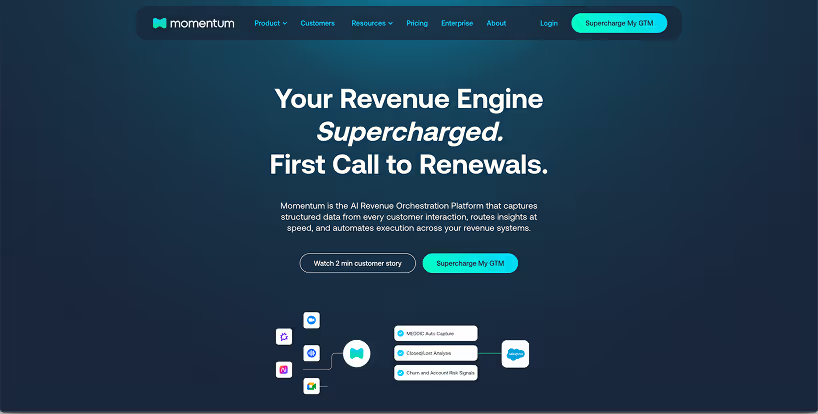
While many platforms focus on analytics, Momentum focuses on action. We act as an AI Agent that lives inside your workflow.
::autoboxgrid2
[LEFT]
Best for: Teams that want to automate the grunt work (CRM entry, summaries) while delivering personalized coaching directly in Slack or the tools reps already use.
[RIGHT]
The Difference: Momentum captures data-driven insights and immediately operationalizes them. If a rep follows the playbook (e.g., MEDDIC), Momentum auto-fills the CRM. If they miss a step, they get instant feedback. It is the connective tissue between your call data and your revenue operations.
::endautoboxgrid2
2. Gong (Revenue Intelligence)
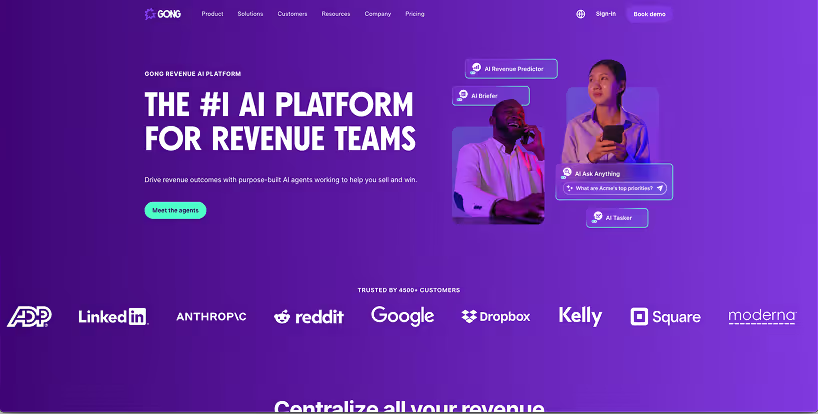
The market leader in visibility. Excellent for understanding the "health" of your pipeline at a macro level.
::autoboxgrid2
[LEFT]
Best for:Sales leaders who need deep analytics on win rates and pipeline health.
::endautoboxgrid2
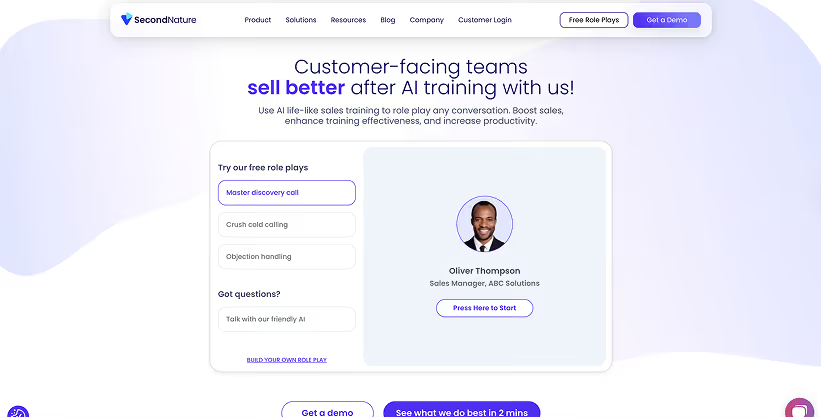
3. Second Nature (AI Role Play)
The market leader in visibility. Excellent for understanding the "health" of your pipeline at a macro level.
::autoboxgrid2
[LEFT]
Best for:Sales leaders who need deep analytics on win rates and pipeline health.
::endautoboxgrid2
How to Implement AI Coaching (Without Breaking Your Team)
Buying the tool is the easy part. Implementation is where sales managers fail. As we discussed in our recent webinar, AI often "uncovers the shenanigans" in your process.
If you don't have a clear sales methodology (SPICED, SANDLER, CHALLENGER), AI will simply amplify your lack of process. Here is your implementation guide:
Step 1: Define "Good" Before You Automate
You cannot train an AI model if you don't know what a top performer looks like.
- What does a good discovery call sound like?
- What are the exit criteria for each stage of the sales cycle?
- What are the top 5 objections regarding pricing?
Document this. This becomes the ground truth for your AI sales coaching tools.
Step 2: Focus on "Micro-Coaching"
Don't try to fix everything at once. Use performance metrics to identify one skill gap per rep. Maybe Rep A needs help with objection handling, while Rep B talks too much (low listen-to-talk ratio). Configure the AI to track and alert on just those metrics for two weeks. Personalized feedback wins over generic advice every time.
Step 3: Automate the "Unsexy" Work
Your reps want to close deals, not fill out forms. Use AI to handle the administrative burden. When reps see that the AI is saving them time (by automating CRM updates or follow-up emails), they will embrace the coaching platform rather than fearing it as "big brother."
Step 4: Scale with AI Role Play
For skill development, move away from peer-to-peer role-play (which often devolves into chatting) and use ai role play. This allows reps to practice messaging 50 times in a row without exhausting a manager's time. This is critical for quota attainment and reducing ramp time.
The Human Element: Where AI Ends and Managers Begin
Does AI sales coaching replace the manager? Absolutely not.
AI provides the diagnostics; the manager provides the cure.
AI can tell you that a rep's win rates are down because they aren't discussing budget early enough. But it takes a human leader to understand why—is it a confidence issue? A lack of product knowledge? Personal stress?
Sales coaching works best when it is a hybrid.
- Let AI handle: Data collection, performance metrics, compliance checks, CRM hygiene, and real-time nudges.
- Let Managers handle: Strategy, morale, career development, and complex deal navigation.
FAQs: Common Questions from Sales Leaders
Q: Will my sales reps hate being recorded?
A: In the past, yes. But today, conversation intelligence is standard. If you position it as a tool to automate their admin work and help them hit quota, adoption skyrockets.
Q: Can AI really handle complex B2B sales cycles?
A: Yes. Modern LLMs (Large Language Models) understand context. They can differentiate between a "hard no" and a "not right now," providing actionable insights that align with complex enterprise deals.
Q: How fast will we see ROI?
A: With real-time feedback tools, you can see behavioral changes in weeks, not quarters. When you fix objection handling across the board, revenue growth follows naturally.
The Future is Automated and Coachable
The era of the "ride-along" is over. The era of the "always-on" coach is here.
Your tech stack shouldn't just be a place to store data; it should be an active participant in your revenue team. By integrating Momentum and AI-driven coaching, you are not just buying software—you are building a scalable, predictable, and high-performing revenue engine.
Don't let your team practice on your prospects. Give them the benefits of ai and watch your individual performance metrics climb.
[blue-section]
Ready to Turn Your Workflow into a Coaching Engine?
Stop relying on retrospective data and start influencing deals in real-time. Momentum brings your sales methodology, coaching, and automated workflows together in one platform.
See how Momentum acts as the "connective tissue" for your revenue team.
[/blue-section]